
Voluntary Agency Network of Korea has launched a digital-based global campaign to raise awareness of the historical context of African cultural heritage removed overseas during the imperial era and to build international consensus on the need for its return.
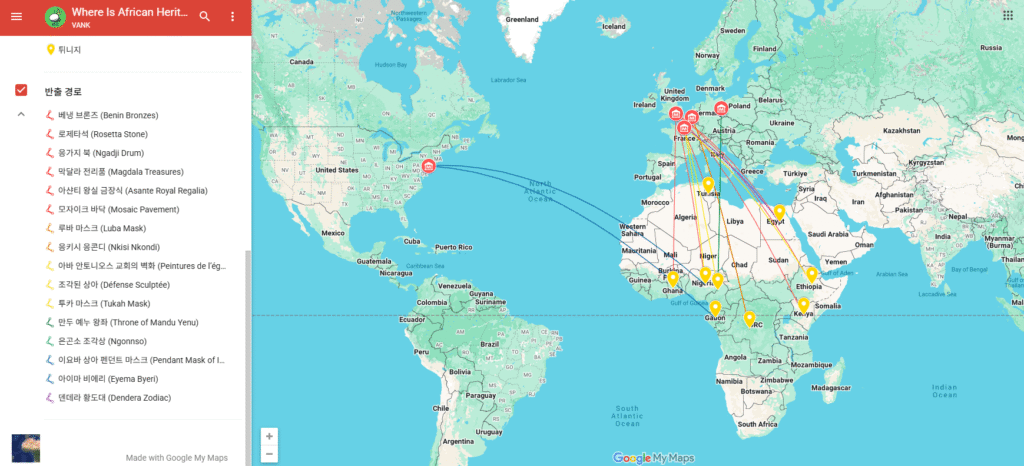
VANK announced that it has created and released an “African Cultural Heritage Digital Map,” which allows users to view at a glance the current locations and removal routes of African artifacts. Alongside the map, the organization is also promoting a participatory Google Maps review campaign under the hashtag “#HeritageHasHistory.”
A significant number of cultural artifacts originating from Africa are currently housed in Western museums, many of which were taken during the colonial period through looting and forced collection. As a result, calls for their return have continued to grow within the international community.
The digital map released by VANK is designed to present these movements and their historical background in an intuitive format. It displays both the place of origin and current location of African artifacts, with lines connecting the two points to visualize their routes of removal.
When users click on a museum pin, they can view information about the African cultural items held by that institution in the form of image cards. Each card includes details on the artifact’s background, historical significance, circumstances of removal, and current status—such as not returned, on long-term loan, or under discussion for repatriation. The content is provided in both Korean and English.
VANK is also running a citizen-participation campaign using the Google Maps platform. Participants can click on museum pins on the digital map, navigate to the institution’s review page, research the history and removal background of the African artifacts, and share their findings using the hashtag “#HeritageHasHistory.”
Collected reviews will be continuously reflected in the digital map, contributing to ongoing updates and allowing it to evolve into a participatory archive that expands over time.
Following the campaign’s launch, user reviews have already begun appearing on the Google Maps pages of major European institutions, including the Musée du quai Branly, Humboldt Forum, and Royal Museum for Central Africa.
Examples include posts sharing the case of the Benin Kingdom’s “Tête d’autel royal,” which was looted by British forces in 1897 and later transferred to France through auction; renewed attention to the history of the Dogon people of Mali, whose artifacts were taken in large numbers by French expeditions; and discussions surrounding the German government’s decision to return ownership of the Benin Bronzes, alongside calls for continued attention to items that remain on long-term loan.
In one case, a participant wrote in a review of the Royal Museum for Central Africa that the institution’s official website did not clearly explain how the artifacts were acquired, making it difficult to understand their history. The participant then shared information about imperial-era looting and strategic collection learned through the campaign, helping other visitors better understand the context.
The campaign is significant in that it is designed to first help users understand cultural heritage through the digital map and then encourage them to share that information on global platforms, enabling citizens to actively engage in issues of cultural heritage repatriation. Moving beyond expert-led discussions, it represents a new model of “digital public diplomacy,” in which ordinary citizens play a direct role in sharing historical facts and building consensus.
The use of visualized maps and content is also expected to make the campaign effective in educational settings by clearly conveying the routes of artifact movement and their historical context.
Park Gi-tae, head of VANK, said, “In the digital age, where people can visit museums around the world with just a smartphone, restoring justice for cultural heritage has also become possible through the actions of citizens online.” He added that VANK aims to build international public opinion for the return of African cultural heritage by combining global digital platforms with the voices of global citizens.
Choi Ju-eun, a youth researcher who planned the campaign, said, “We hope people will explore the movement of artifacts through the familiar platform of Google Maps and naturally take part in the campaign.” She added that the accumulated review data from participants is expected to serve as a meaningful record supporting discussions on the return of cultural heritage.
The digital map can be accessed through the link below and via the QR code on the campaign poster:
https://www.google.com/maps/d/viewer?mid=14CPo6HPPPF9l7iPB_l802KCRT3KvS_k&gl=KR