
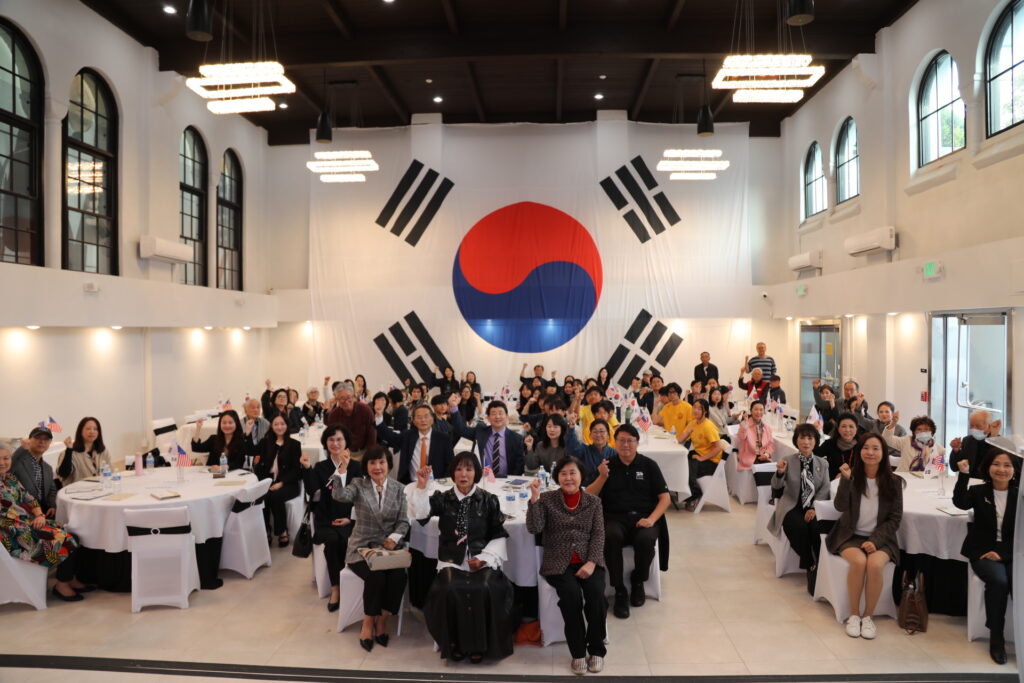
A special lecture held on October 25, 2025, at the San Francisco & Bay Area Korea Center to mark the 80th anniversary of Korea’s liberation delivered a message that went well beyond history. Titled “80 Years of Liberation: We Are Korea, We Are Global Hallyu Ambassadors,” the event underscored a central idea repeated throughout the evening: diplomacy is no longer the work of governments alone. In the digital age, ordinary citizens—especially overseas Koreans—are increasingly shaping how Korea is seen by the world.
Hosted by the San Francisco & Bay Area Korea Center, the lecture featured Park Gi-tae, head of VANK, along with researchers Koo Seung-hyun and Kwon So-young. Between 100 and 200 Korean Americans from across Northern California attended, including president Kim Han-il, as participants reflected on people-led diplomacy, historical responsibility, and the role of younger generations.
The event opened with a short video introducing VANK’s mission. “We are not diplomats, but we become friends with people around the world and introduce them to our friend’s country, Korea,” the narration said. Another line—“We are not independence activists, but we carry out independence movements in the 21st century”—set the tone for the evening, drawing quiet focus from the audience.
Taking the stage, Park traced his journey from a college student running a small pen-pal website to founding VANK in 1999. He described discovering that global textbooks and maps often portrayed Korea as a marginal space between China and Japan, with the East Sea labeled solely as the “Sea of Japan” and Dokdo marked as “Takeshima.”
“I was neither a diplomat nor a historian,” Park said. “But I realized this was something even an ordinary person could challenge.” He recalled emailing a major publisher to point out the errors and receiving a reply just 10 days later confirming the material would be reviewed and corrected. Similar actions soon spread among Korean students and overseas Koreans worldwide.
“That small action changed a book,” Park said. “That is the power of people-led diplomacy.”
He explained that when VANK began, only about 3 percent of world maps used the name “East Sea,” while nearly all showed only “Sea of Japan.” Today, more than 40 percent recognize dual naming, a shift he said was achieved largely through sustained civic action rather than government directives.
“The real issue is not just a name on a map,” Park said. “It’s whether Korea exists in maps, textbooks, and history at all.” He added that correcting distortions is no longer the responsibility of scholars or officials alone, but of ordinary citizens.
Park also connected today’s efforts to the independence movement rooted in San Francisco, naming figures such as Ahn Chang-ho, Jang In-hwan, Jeon Myeong-un, Rev. Lee Dae-wi, and Kim Jong-rim. “In the early 1900s, young people and first-generation immigrants became Korea’s diplomats,” he said. “That spirit is still alive. The moment we say, ‘I am Korean,’ that itself is diplomacy.”
The second speaker, Koo Seung-hyun, said the struggle over Korea’s image now extends far beyond textbooks. “It happens every day in museums, bookstores, tourist sites, online searches, and on maps,” she said. She cited U.S. and British materials that frame Korea as a region once ruled by China, shaping the perception that it lacked an independent civilization.
She also pointed to errors on major tech platforms. Even Google, headquartered near San Francisco, has displayed Dokdo as the “Liancourt Rocks,” often treating the Japanese name “Takeshima” as a default. Because this information appears in Google’s knowledge summaries, she said, it is widely consumed as standard fact.
Koo shared a case from the COVID-19 pandemic, when World Health Organization maps showed Dokdo included in Japan’s territory but omitted from Korea’s. After months of petitions and submissions by VANK and its global network, the map was corrected. She also described personally emailing a museum in Dallas after finding the East Sea mislabeled, leading to a correction the very next day.
“All I did was send an email,” she said. “Anyone can do that. This is what independence activism looks like today.”
The third speaker, Kwon So-young, focused on distortions emerging through artificial intelligence. She showed AI-generated images of hanbok that resembled Chinese or Japanese clothing and depictions of Korean landmarks that bore little resemblance to reality. “AI is blending Korean culture into a vague Chinese or Japanese image,” she said.
Kwon explained that AI systems learn from existing English-language data, much of which reflects colonial-era or geopolitical perspectives rather than Korean viewpoints. “In the past, an error stayed in one book,” she said. “Now it spreads instantly through AI answers.”
VANK, she said, sees this as an “independence movement in the AI era” and operates platforms that allow youth to collect errors and submit formal policy proposals to government agencies. These efforts have already led to corrections in official educational materials.
The atmosphere at the event was intense and emotional. Kim Han-il described San Francisco and the Bay Area as a “sacred ground of the independence movement,” recalling how donations, letters, and activism by Korean immigrants helped lay the foundation for Korea’s independence. He also cited recent community actions, including campaigns that led Google to correct Dokdo labeling and the establishment of the San Francisco comfort women memorial.
“This room is already filled with Korea’s ambassadors,” Kim said, urging attendees to take the next step.
After the lecture, the association and VANK signed a memorandum of understanding to jointly develop history and culture programs for younger generations, operate youth diplomacy camps, and carry out online campaigns promoting Korea through Korean-American and Hallyu fan networks.
VANK also announced plans to propose the appointment of independence activist Kim Jong-rim (1884–1973)—a Korean-American pioneer known as the “Rice King”—as a public relations ambassador for South Korea’s Ministry of National Defense. Kim co-founded the Young Korean Academy and helped establish the Willows Korean Aviation School, regarded as the origin of the Republic of Korea Air Force.
More than a lecture, the event marked a turning point built around a simple but powerful idea: We are Korea. As one young attendee said afterward, “This reminded me that being Korean is not just an identity—it’s a responsibility.”
VANK announced that the San Francisco event would be followed by lectures in San Diego and Los Angeles, continuing its effort to link Korea’s independence history with today’s global, digital diplomacy.