
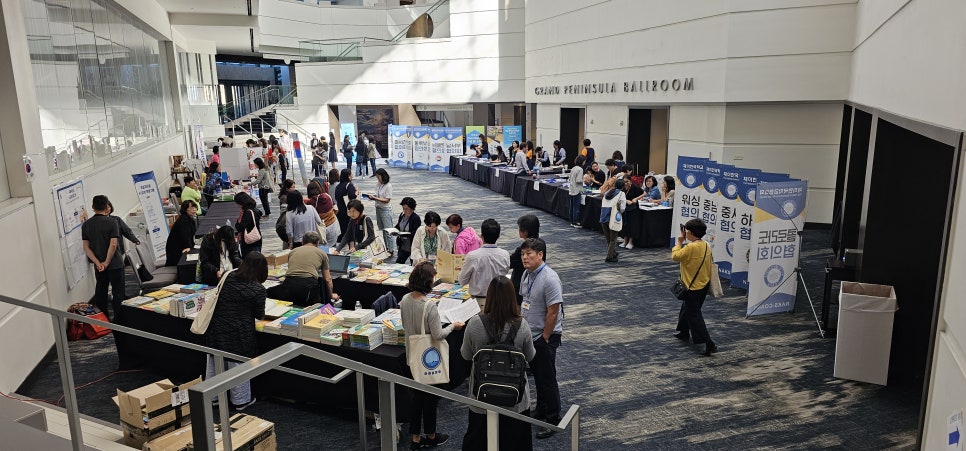
The Voluntary Agency Network of Korea (VANK) was invited to participate in the 41st annual conference and general meeting of the National Association for Korean Schools (NAKS), held from July 20 to 22, 2023.
Founded in 1981, NAKS is a nonprofit organization with over 1,200 member Korean schools and approximately 9,000 teachers across the United States. Through these schools, roughly 30,000 students are learning Korean language and culture.
Since signing a memorandum of understanding (MOU) with NAKS in August 2018 to promote accurate knowledge of Korea, VANK has continuously conducted Global Korea Ambassador training programs for Korean school teachers and young Korean-Americans.
This year’s NAKS conference, the first in-person meeting in three years following the COVID-19 pandemic, was held in San Francisco under the theme, “The Direction of Next-Generation Education in the 21st Century.” About 450 teachers from Korean and Hangeul schools across North America, along with representatives from major domestic and international partner organizations, attended.
On the first afternoon of the conference, July 20, 2023 (San Francisco local time), the program included a variety of academic sessions and lectures led by experts in Korean language education, history, Dokdo education, and writing instruction. Among them, VANK’s Project Researcher and Director of the Dokdo History and Culture Research Institute, Kim Bong-soo, delivered a lecture titled “New Hallyu Unfolding on the Map.”
Key Points of the Lecture:
Korea 100 Years Ago
A century ago, Korea had lost its sovereignty to Japan and could not participate in any international activities. In 1929, when the international standard maritime map was published showing only the name “Sea of Japan,” Korea could neither attend the meeting nor express any opinions.
Korea Today
Unlike a hundred years ago, Korea now actively participates in international decision-making across fields such as oceanography, geography, place names, aviation, and space, including the development of the next-generation digital nautical chart standard by the International Hydrographic Organization. Korean representation in international organizations is expanding, and Korea holds top global rankings in shipbuilding and aviation exports.
If Silla once led East Asian maritime order in the 9th century through Jang Bogo’s trade, Korea today can be said to lead international maritime order through maritime law, trade, and science and technology.
Alongside Korea’s growing influence in international affairs, VANK works to correct inaccurate information overseas regarding Korea’s place names, territory, history, and culture, promoting accurate understanding of the country worldwide.
Korea’s Future
As of 2022, the number of Hallyu fans worldwide has surpassed 178 million, reflecting unprecedented global interest in Korea. To ensure that Hallyu continues to spread correctly, it is crucial to educate young Korean-American students about Korea based on historical facts and to actively correct misinformation about Korea abroad.
VANK believes that if Korean schools, teachers, students, and local Korean communities worldwide participate in these efforts, Korea’s positions and demands can exert greater influence.
There are already encouraging examples: U.S. textbooks that previously taught only “Japan Sea” now include the East Sea following the 2014 Virginia state law and 2019 New York State Education Department guidelines, spreading knowledge of the correct name across the United States and globally. These results reflect the dedication of Korean schools and communities in the U.S.
By continuing to provide accurate information about Korea’s place names, history, and culture, and correcting misinformation when it arises, overseas audiences can gain a fuller understanding of Korea beyond K-Pop, dramas, and cuisine, recognizing its long history, maritime territory, and cultural heritage.
Ways to Cooperate
Korean schools and local communities can continue educating students about Korean language, history, culture, territory, and place names, helping them develop a strong identity as Koreans and Korean-Americans. Based on this knowledge, students can inform others who are unaware of or misinformed about Korea, share high-quality content, and help propagate accurate information internationally.
If overseas media contain inaccuracies about Korea, including incorrect place names, VANK advises requesting corrections based on facts. If it is difficult to resolve alone, VANK can assist in finding solutions.
Through its “21st-Century Yi Sun-sin Error Correction Project” website, VANK shares expertise and sample letters accumulated from past overseas correction efforts and allows users to report errors. Policy measures or matters requiring international attention can also be raised through petitions.
Closing Remarks
From Jang Bogo in the 9th century, who expanded maritime trade despite pirate attacks, to Admiral Yi Sun-sin in the late 16th century, who defended the nation with limited forces, to Ahn Yong-bok in the late 17th century, who clarified Dokdo and Ulleungdo as Joseon territories to Japanese officials, and to the 1907 Hague emissaries who were unable to participate in peace conferences, Korea’s history has been full of challenges. Today, however, Korea has unprecedented opportunities to promote itself globally.
With increasing international interest in Korea and its growing influence in the global community, VANK and Korean schools can work together to ensure that Hallyu spreads correctly and that misinformation is gradually eliminated.
Key Q&A
Q: Why does Korea not seek resolution of the Dokdo issue through the International Court of Justice (ICJ)?
A: Dokdo is Korea’s sovereign territory, not a disputed area between Korea and Japan. Japan’s unilateral claims are incorrect. Judicial resolution through international organizations like the ICJ is unnecessary; Japan must stop making false claims on its own.
Q: With the International Hydrographic Organization moving to next-generation digital nautical charts, will place name labeling using digital identifiers spread to private maps, and how long might that take?
A: While exact timing is uncertain, as the next-generation digital chart standards are developed and adopted internationally, private maps and nautical charts are expected to gradually use digital identifiers to prevent conflicts over place names worldwide.
Q: Where can I find educational content or promotional materials about Korea?
A: Many schools and local associations have developed excellent materials. VANK also provides online content and resources for overseas use.
Following Kim Bong-soo’s lecture, NAKS President Park Ki-tae introduced VANK’s past activities and highlighted promotional materials available to schools and Korean communities, including the newly launched “Ilhum” service, which gives Korean names to foreign friends, and eleven other materials such as Korean and world maps, cultural postcards, and Hangeul keyboard stickers.
This lecture marked a commitment for continued communication and collaboration between VANK and Korean schools to promote accurate and widespread understanding of Korea abroad.
VANK also participates in academic conferences on Korean culture, history, Hangeul, unification, and other topics. On the final day of the NAKS conference, July 22, 2023, President Park Ki-tae will deliver a special lecture titled “We Are the Hallyu Ambassadors.”