
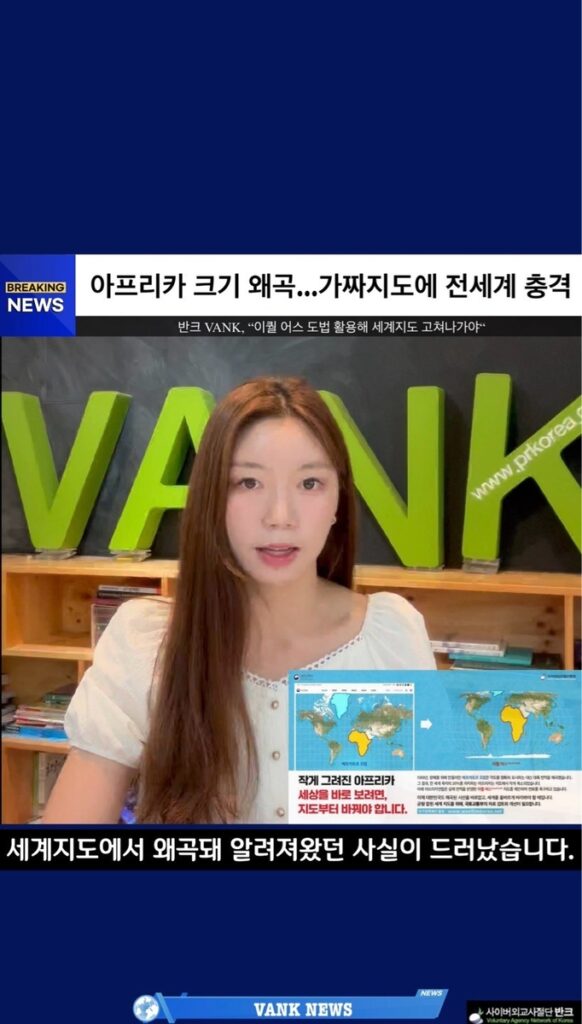
VANK is ramping up its online campaign to raise awareness about distorted world maps and the misperceptions they create. Through a series of videos released on its official Instagram account, VANK has launched a multifaceted initiative that moves from problem recognition to solution proposals and public engagement.
From Street Interviews to Global Awareness
The campaign began on the streets. VANK interviewed foreigners and international students from countries including the United States, Algeria, Canada, and Hungary. The results were striking: many participants associated Africa primarily with poverty and famine—and few knew the continent’s actual size. The findings revealed how the small depiction of Africa on maps has long shaped distorted perceptions of reality.
Exposing the Map’s Hidden Bias
In the second video, a VANK youth researcher appeared as a news anchor to explain the roots of the issue. The widely used Mercator projection, they noted, exaggerates northern regions while shrinking those along the equator, causing Africa and South America to appear much smaller than they truly are.
The video emphasized that Africa—large enough to contain the United States, China, and all of Europe combined—has been visually minimized and thus often reduced to a “continent of poverty” in global consciousness.
Turning Awareness into Action
The third video transformed the campaign into a participatory movement titled the “U-Know Yunho Lesson Challenge.” Using a meme-style short video format, it appealed to younger audiences, particularly the MZ generation (Millennials and Gen Z). Viewers were encouraged not only to watch but to actively share accurate world maps with the hashtag #CorrectTheMap, expanding the message through social media participation.
What began as a message-driven initiative has now evolved into an interactive campaign, empowering the public to join in amplifying awareness.
A Campaign with Broader Significance
Drawing inspiration from Korea’s own experience of correcting historical distortions and preserving its national identity, VANK’s campaign carries symbolic weight in addressing global misrepresentations. By leveraging the media habits of younger audiences and presenting information through short-form videos, the initiative has boosted both accessibility and outreach.
Kim Ye-rae, the VANK youth researcher leading the campaign, explained, “Our goal goes beyond correcting map recognition—it’s about changing how the world views Africa. We wanted to approach the issue not just by pointing out the problem, but through a more systematic and strategic framework.”
Looking Ahead
Building on this momentum, VANK plans to:
- Expand social media–based participation challenges,
- Create and distribute alternative world maps using equal-area projections, and
- Collaborate with international organizations to advocate for map reform.
VANK head Park Ki-tae noted, “Just as Korea overcame the scars of colonialism and war to achieve growth, Africa too is moving beyond its colonial past toward a new future.”
He added, “Through this campaign, VANK aims to lead global efforts to correct misconceptions, promote balanced worldviews, and inspire Korean youth to play a leading role in reshaping global awareness.”