
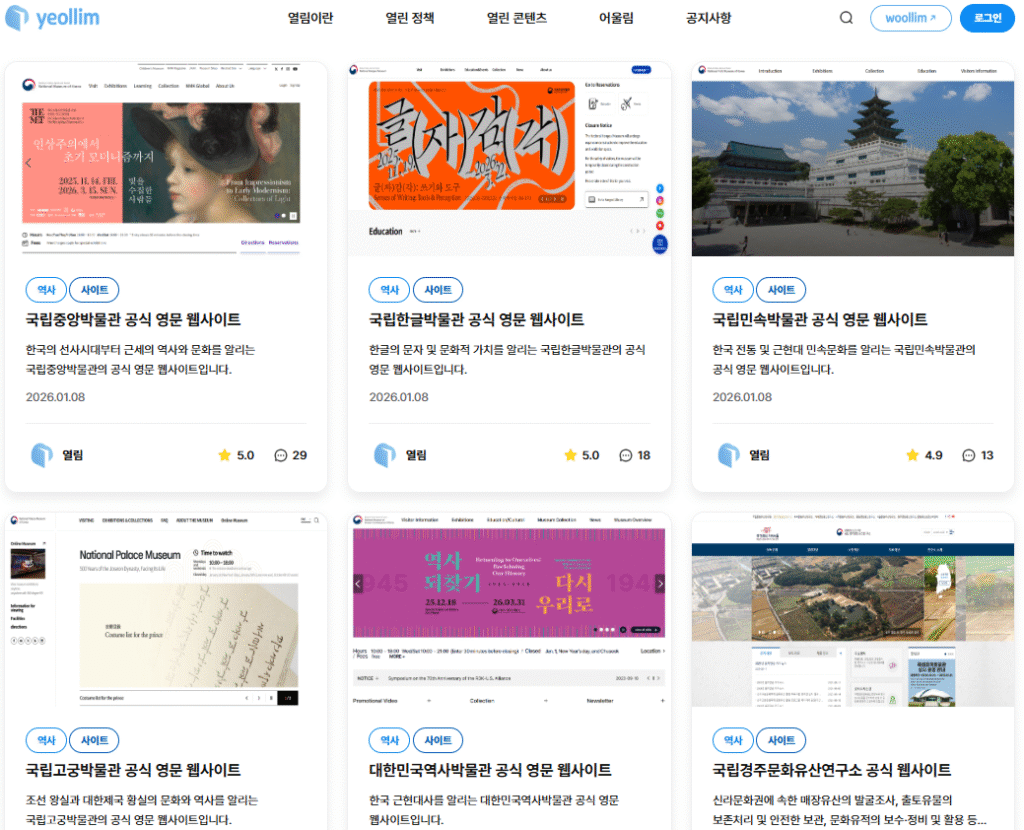
VANK has launched a campaign to evaluate the online content of South Korea’s major museums, inviting teenagers, young adults, and foreign residents to take part through the government’s national policy communication platform, “Yeollim.”
The campaign focuses on the official English-language content of leading institutions, including the National Museum of Korea, the National Hangeul Museum, the National Folk Museum of Korea, the National Palace Museum of Korea, and the National Museum of Korean Contemporary History.
Based on evaluations and suggestions submitted directly by participants, VANK plans to review the quality of these online materials and propose ways to improve them. The effort comes amid a sharp rise in foreign visitors to Korean museums, fueled by the global popularity of Korean cultural content such as K-Pop Demon Hunters. VANK aims to ensure that international audiences can gain a more accurate and in-depth understanding of Korea’s history and culture through museum websites.
For foreigners who are unable to visit Korea in person, the official English websites of national museums often serve as the first point of contact and a key source of information about the country. VANK said it will present concrete recommendations to help these sites better convey Korea’s historical depth and cultural context.
The group has carried out similar initiatives in the past. In July 2025, VANK conducted an online campaign through Yeollim to assess digital content produced by the Overseas Koreans Agency and its affiliated institutions. Teenagers, young people, and overseas Koreans took part in evaluating how effectively government policies and online services for overseas Koreans were being delivered and whether they met users’ expectations.
Park Gi-tae, head of VANK, said K-Pop Demon Hunters has played the role of a cultural ambassador for Korea. “Scenes in which the characters enjoy traditional Korean foods like sundae, seolleongtang, and naengmyeon have gone viral worldwide, sparking a surge of interest in Korean food and culture,” he said.
Park added that the true value of the work lies in its message of solidarity, hope, and courage in the pursuit of justice, reflected in lyrics about lighting the darkness together and changing the world through a shared voice. “It shows that the Korean Wave can be a source of cultural energy that brings positive change to the world,” he said.
He also noted that foreigners who become interested in Korea through Korean Wave content often turn first to the official English websites of national museums. “This campaign will help museum content evolve to meet global expectations and present Korea’s history and culture in a more engaging way,” he said.
Kwon So-young, a researcher at VANK, stressed that sustained cultural exchange requires more than short-lived trends. “To ensure that foreign interest in Korean history and culture leads to lasting engagement, there must be systematic efforts to manage and improve the quality of online content,” she said. “As gateways for sharing Korea’s cultural identity with the world, museum websites need ongoing evaluation and feedback systems.”
Koo Seung-hyun, another researcher, said the campaign would be a meaningful step toward improving the quality of online cultural information, which increasingly shapes a country’s image in the age of artificial intelligence. “By having teenagers, young adults, and foreigners directly analyze English-language museum content and suggest improvements, this initiative will raise standards,” she said. “Continual review and improvement from the perspective of the younger generation are essential to presenting Korean history and culture in a way that resonates with a global audience.”