
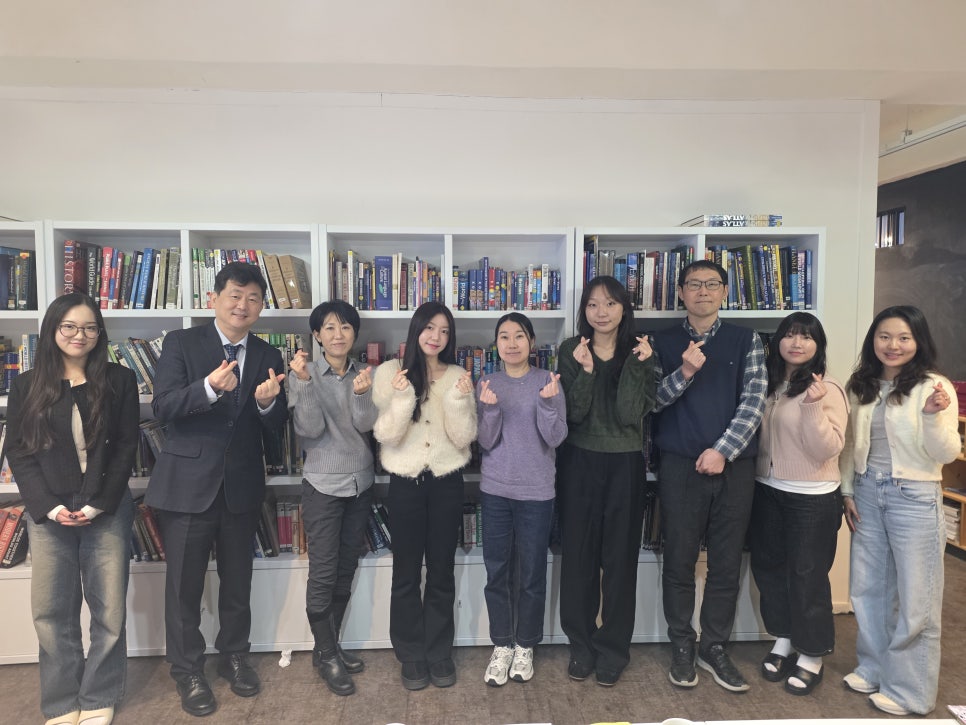
Cyber Diplomacy Organization VANK and the National Research Institute of Cultural Heritage held the “Global AI Strategy Seminar” on December 3, 2025, at VANK’s Bomun Office in Seongbuk-gu, Seoul.
The two organizations signed a memorandum of understanding last September to cooperate on the protection, use, and promotion of cultural heritage research outcomes. At the time of the agreement, they identified the “AI Cultural Heritage Ambassador Training Program” as a key initiative. Through VANK’s national policy proposal platform Woollim, the project aims to correct errors and distortions related to Korean cultural heritage found in generative AI content, while also training youth and young adults as digital ambassadors to promote the true value of Korean cultural heritage worldwide.
This seminar was held as an extension of that partnership, with the goal of exploring strategies and directions for accurately presenting Korean cultural heritage in the age of AI.
As global competition for AI leadership accelerates, VANK emphasized that safeguarding technological sovereignty alone is not enough. It argued that Korea’s history, culture, and national identity reflected within AI systems must also be protected. The National Research Institute of Cultural Heritage’s extensive research and preservation data were highlighted as a key asset in securing Korea’s “identity sovereignty.” If properly incorporated into generative AI training, this data could serve as a foundation for accurately conveying the true value of Korean cultural heritage to the world.
At the seminar, VANK researcher Kwon So-young delivered a presentation titled “The Current State, Causes, and Pathways of AI Distortion of Korean History and Culture.” Her presentation focused on cases of distorted representations of Korean cultural heritage, the structural causes and pathways of information bias, and the spread of digital imperialism and the need for countermeasures.
Kwon illustrated the seriousness of the issue by presenting examples of distorted images and texts generated by AI. In some cases, Gyeongbokgung Palace was incorrectly depicted as Osaka Castle in Japan, while the Buddha statue of Seokguram Grotto was shown placed outside the cave rather than inside. Such inaccurate images, she noted, were being generated repeatedly.
“These errors are not simple technical mistakes,” Kwon said. “They are the result of biases and distortions already embedded in AI training data.” She explained that source materials such as foreign textbooks, encyclopedias, media reports, websites, and social media contain widespread inaccuracies related to Korea, which are then learned and reproduced by AI systems.
She further warned that this imbalance of information distorts how Korea is presented to global audiences through AI, calling it a form of 21st-century digital imperialism. “In the past, power was exercised through military occupation of territory,” she said. “Today, dominance is achieved by controlling information and cultural narratives.”
Kwon also shared the results of a study in which images of Korean cultural heritage were requested from major generative AI platforms, including ChatGPT, Gemini, Copilot, and Grok.
Four different rock-carved Buddhist statues—the Icheon Jangam-ri Rock-carved Standing Bodhisattva, the Icheon Yeongwolam Rock-carved Standing Buddha, the Hanam Gyosan-dong Rock-carved Medicine Buddha Seated Statue, and the Paju Yongmi-ri Rock-carved Standing Buddhas—were all generated as nearly identical images. This showed that AI systems had failed to learn the unique characteristics of each heritage site and instead relied on oversimplified data. In addition, the Face-pattern Roof-end Tile, a National Treasure and the motif for the APEC logo, was frequently reproduced in forms completely different from the original.
Kwon also pointed out that major generative AI platforms repeatedly portray Africa through negative images such as poverty, conflict, and disease. As part of its global advocacy efforts, VANK has been urging major AI companies and platforms to correct distorted data about Africa and to adopt more balanced training algorithms.
“To protect Korea’s history and culture in the digital environment, we need proactive strategies based on accurate information and standardized data,” Kwon said. As a core solution, she proposed the concept of “Global Sovereign AI.” She described it as a new paradigm in which countries secure information sovereignty over their own history and culture while working together internationally to build an AI ecosystem that respects cultural diversity. She emphasized that the National Research Institute of Cultural Heritage’s research data and expertise would play a decisive role in this process.
Following the presentation, VANK’s youth researchers shared concrete ideas for strengthening cultural heritage sovereignty in the AI era.
Youth researcher Lee Sei-yeon noted that AI systems often fail to recognize even basic information about cultural heritage. He identified the root cause as the lack of referenceable standard datasets and proposed a “Regional Core Cultural Heritage Standard Dataset Project” to address the issue.
Under this proposal, key cultural heritage sites would be selected based on regional representation and frequency of exposure to foreign audiences. Standard datasets would be created and made public, including names, historical periods, locations, key visual elements that AI should reflect, and representative images. Lee explained that this would improve AI accuracy and allow users to request corrections based on clear standards. As a result, AI systems would be better able to reproduce the identity and distinctive features of each cultural heritage site.
Another youth researcher, Baek Si-eun, suggested expanding the National Research Institute of Cultural Heritage’s AI-based image search service, Cultural Heritage Finder-ZOOM, into an “AI Cultural Heritage Distortion Monitoring Center.”
She proposed that VANK and the institute jointly analyze distortion cases across major generative AI models—including text, images, maps, and intangible heritage—categorize them by type, and systematically manage AI-specific error patterns. By prioritizing high-risk heritage sites and continuously accumulating accurate data, she argued, the institute could evolve into a global hub for authoritative cultural heritage data in the AI era.
Youth researcher Kim Ye-rae introduced short-form videos produced by VANK that verify AI errors and emphasized the need for public-facing digital campaigns that encourage direct participation. She proposed regularly publishing a “Cultural Heritage AI Fact-Check Report” series in connection with the Global AI Cultural Heritage Ambassador Program. The series would follow a format of “incorrect answer → explanation of the error → correct information” on platforms such as Instagram Reels and YouTube Shorts, turning AI reliability issues into an educational campaign that the public can easily understand. She also stressed the value of expanding this into a “one-minute reels” format featuring experts directly explaining AI errors.
VANK Director Park Gi-tae said that the National Research Institute of Cultural Heritage, which has long carried out scientific and systematic work from the discovery to the restoration of cultural heritage, could now take on a new role as a “digital restorer” in the AI era by correcting distorted cultural heritage information online. He added that if the two organizations jointly develop model prompt techniques for accurate AI-based cultural heritage representation, they could set a new standard for cultural heritage protection in the age of AI.
Cho Eun-kyung, Director of the Research Planning Division at the National Research Institute of Cultural Heritage, said that in an era when AI technology affects all aspects of cultural heritage research, preservation, and use, building accurate and standardized data is a core task in safeguarding national cultural heritage sovereignty. She added that the institute will work with VANK to ensure the reliability and public value of AI-based cultural heritage data and to lead global digital cultural heritage governance.
VANK researcher Koo Seung-hyun noted that Korea, which aims to become one of the world’s top three AI powers, bears a responsibility to protect its cultural heritage properly and share it with the world to promote diversity and balance in human culture in the AI era. He added that if Korea develops and spreads an “AI Cultural Heritage Contribution Model” that combines heritage preservation with technological innovation, it could chart a new path as an AI power that contributes through culture, not just technology.
The seminar was widely seen as a model case of public–private cooperation, demonstrating how Korean cultural heritage can be accurately recognized and fairly represented despite the growing risks of information distortion in the age of AI.