
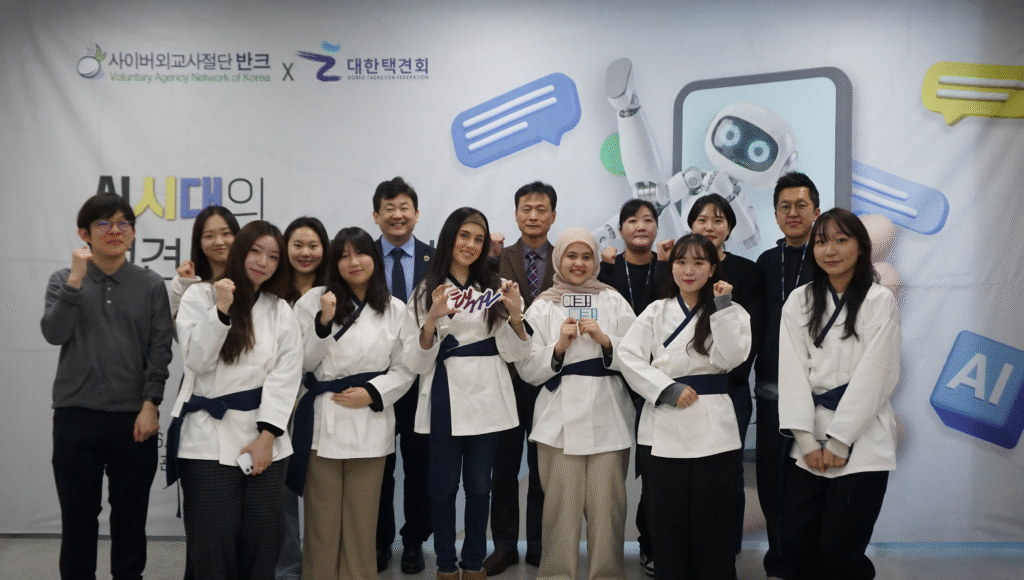
VANK held the “Taekkyeon Promotion Strategy Seminar in the AI Era” on January 16, 2026, at the Olympic Hall, jointly with the Korea Taekkyon Federation.
Since signing a memorandum of understanding (MOU) with the Korea Taekkyon Federation in 2023, VANK has continued to pursue joint projects aimed at popularizing and globalizing taekkyeon. The organization is also carrying out a global promotion initiative for taekkyeon in cooperation with the Korea Culture Foundation, chaired by Kim Jun-il.
Ahead of the seminar, VANK held a ceremony to confer honorary rank certificates on newly appointed young researchers.
At the seminar, Ahn Chi-young, deputy director of the Korea Taekkyon Federation, shared key projects and case studies from the past year and outlined strategies for promoting taekkyeon globally.
Ahn noted that among the 64 sports currently registered as full members of the Korean Sport & Olympic Committee, as many as six originate from Japan, while taekwondo remains the only Korean-origin sport recognized by Olympic committees worldwide. “At a time when K-culture is receiving global attention, the Korea Taekkyon Federation is exploring a new direction to address the absence of ‘K-martial arts’ and ‘K-sports’ on the world stage,” he said.
He emphasized that taekkyeon is a representative martial art that has been enjoyed by people across social classes and generations since the Joseon Dynasty, 111 years before the first modern Olympics. “What globally successful K-content has in common is that it draws from what is most uniquely Korean,” he said, adding that the association is seeking ways to preserve taekkyeon’s essence while adapting it to contemporary contexts.
Based on this philosophy, the association has pursued various efforts to harmonize tradition with a modern sports sensibility. Ahn explained that scoreboards displaying match information incorporate traditional design elements, while the start and end of matches are marked by the sound of a traditional gong instead of a buzzer, creating a distinctly Korean visual and auditory experience.
He also said that in preparation for the AI era, the association has built AI training datasets by recording all taekkyeon movements by skill level and has made them publicly available through the government-run AI Hub. “We will further strengthen the digital transformation of taekkyeon so it can be applied in areas such as e-sports and AI technology,” he said.
Kwon So-young, a VANK researcher, then introduced the organization’s AI-related initiatives and delivered a presentation titled “The Current State, Causes, and Pathways of AI-Driven Distortions of Korean History and Culture.” Her presentation focused on cases of distorted representations of Korean heritage, the structural causes and transmission pathways of information bias, and the spread of digital imperialism.
She cited examples from AI-generated images and texts, including cases in which Gyeongbokgung Palace was depicted as Japan’s Osaka Castle or the Buddha statue of Seokguram was shown outside a cave. “These errors are not simple technical mistakes,” she said. “They stem from biases and distortions already embedded in AI training data, including overseas textbooks, encyclopedias, media outlets, websites, and social media platforms.”
She added that such information imbalances distort how Korea is presented to global audiences through AI, calling the phenomenon a form of 21st-century digital imperialism. “In the past, dominance was imposed through military force. Today, it operates through control of information,” she said.
Koo Seung-hyun, another VANK researcher, shared the outcomes of VANK’s taekkyeon promotion projects and reported on errors related to taekkyeon found in generative AI systems.
VANK has promoted what it calls its five major campaigns to expand the social value and global potential of taekkyeon: adoption as an official Olympic sport, inclusion in the Asian Games, enactment of a Taekkyeon Promotion Act, incorporation into school curricula, and designation of a national “Taekkyeon Day.”
To communicate these efforts more effectively, VANK produced illustrated card-style visual posts and short-form video content titled “Taekkyeon to the World.” As a result, two short videos posted on VANK’s official Instagram account recorded about 7.47 million views, while five visual card posts garnered about 93,000 views, for a combined total of approximately 7.57 million views.
VANK also identified cultural distortion in generative AI as a potential obstacle to the globalization of taekkyeon. Its research found two main types of errors: text-based inaccuracies and image generation errors. Text errors included confusing taekkyeon with taekwondo or inventing non-existent techniques. Image generation tools showed repeated issues, with some producing unrelated visuals or mixing in Japanese cultural elements.
The study also found inconsistencies in which identical prompts generated different responses each time, underscoring weaknesses in AI systems’ cultural accuracy and reliability.
Youth researchers from VANK then presented concrete ideas for promoting taekkyeon in the AI era, including digital campaigns, global participatory challenges, documentary-style short-form content, authoritative data construction, and cross-platform social media initiatives targeting younger audiences worldwide.
Park Gi-tae, head of VANK, said humanity is undergoing a transformation so profound that history may one day be divided into eras before and after AI. “This seminar was a meaningful opportunity to explore strategic ways to promote taekkyeon globally amid this shift,” he said.
He added that while taekkyeon embodies the spirit and identity cherished by independence activists a century ago, promotion strategies must now move beyond offline, physical approaches toward non-physical, digital-first dissemination suited to the AI era.
Oh Sung-geun, secretary general of the Korea Taekkyon Federation, said taekkyeon is a representative folk martial art that developed organically among the people. He noted that generative AI often confuses taekkyeon with other martial arts and stressed the need for high-quality, verified training data.
“This is about properly passing on the philosophy and aesthetics of taekkyeon in the digital environment,” he said, adding that the federation will work with VANK to build standardized digital materials and develop them into a global dissemination system.