
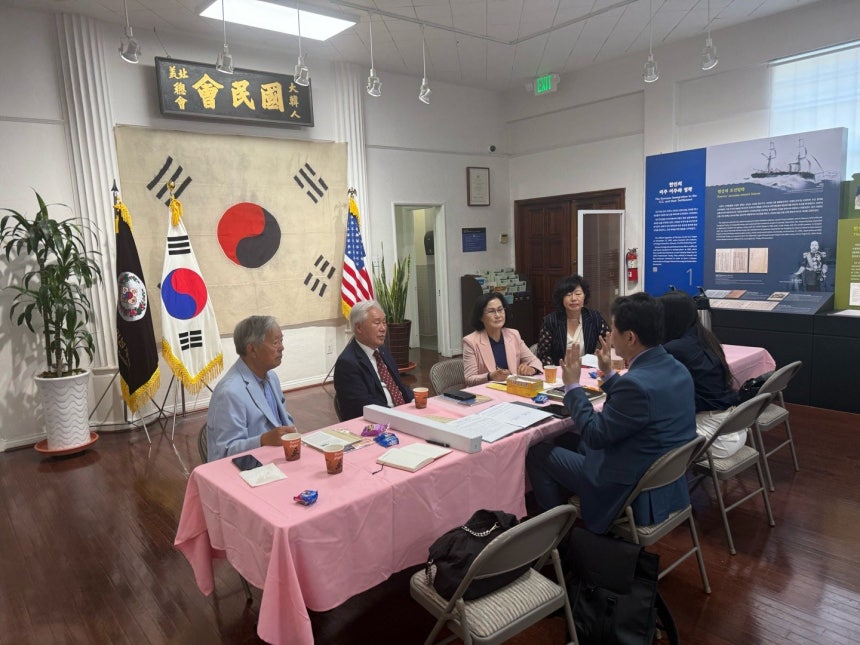
VANK, led by Park Gi-tae, and the Korean National Association Memorial Foundation, chaired by Clara Won, have joined forces to bring the history of Korean immigration to the United States and the spirit of the independence movement to a global audience.
To mark Dosan Ahn Chang-ho Day, the two organizations held an online policy seminar on Oct. 9, 2025, under the theme “Passing On the Values of Korean American Immigration History and the Independence Movement.” The event explored how the legacy of Korean immigrants and independence activists in the United States can be reinterpreted and carried forward across generations.
Nov. 9 marks Dosan Ahn Chang-ho Day, commemorating the birth of Ahn Chang-ho in 1878. The day was proclaimed by the California State Legislature in 2018 and is the first official day in the United States dedicated to honoring the achievements of a non-American historical figure.
Held in honor of Dosan’s birthday, the seminar focused on how the historical legacy of the Korean National Association can be understood and expanded from a modern perspective. Speakers revisited the lives of independence activists remembered by the Korean American community and discussed how the association’s role can evolve beyond its past function as a quasi-government body supporting the Provisional Government of the Republic of Korea, adapting its meaning to the digital age.
Founded in 1909, the Korean National Association functioned as a de facto overseas government for Koreans prior to the establishment of the Provisional Government. In 1914, it was officially recognized by the U.S. government as the representative organization of Korean Americans. Today, the Korean National Association Memorial Hall in Los Angeles serves as a key site documenting the independence movement and early immigration history, offering second-generation Korean Americans a place to learn about their roots and identity.
Clara Won, chair of the Korean National Association Memorial Foundation, said the site still carries the presence of those who protected the nation from abroad. She described the Korean National Association as a place that completed the story of Korean immigration by acting as a provisional government in exile, and stressed that immigration history is not simply a story of the past but a living legacy that each generation must reinterpret and pass on.
During the seminar, VANK and the Foundation agreed to jointly launch a campaign to create a digital memorial hall for Korean American independence activists. The project aims to work with global digital platforms such as Google to build an online space where people around the world can easily access and experience the history of Korean immigration and the independence movement in the United States.
Google operates Google Arts & Culture, a platform that allows users to explore museum and gallery collections from around the world online. Using Google’s ultra-high-resolution Art Camera, artifacts and artworks can be digitized at more than one billion pixels, allowing viewers to see fine details and textures. The platform also offers virtual reality features that enable users to tour exhibition spaces remotely.
Building on this technology, VANK and the Foundation plan to present the historical legacy of the Korean National Association in the form of a digital museum, allowing global audiences to experience sites of the Korean American independence movement with a single click. To support the initiative, the two groups will organize domestic and international signature campaigns and formally submit a cooperation proposal to Google headquarters.
Park Gi-tae noted that last year VANK worked with the San Francisco & Bay Area Korea Center on a global campaign to appoint Korean American patriot Rev. Lee Dae-wi as an honorary ambassador of the Republic of Korea to the United States, drawing strong participation from Korean communities abroad.
“This digital memorial project, like our previous campaigns, will only succeed with broad support and participation from overseas Koreans and the global Korean community,” Park said. “Signing today is a modern way of joining the same spirit of unity that independence activists showed more than a century ago.”
He added that the values of freedom and independence upheld by the Korean National Association align closely with those emphasized in American society and by global technology companies such as Google. Sharing the history of Korean American independence movements through digital space, he said, will help younger generations connect the past to the present in their own language.
Kwon So-young, a VANK researcher responsible for the national policy platform, said the independence spirit left by the Korean National Association is more than historical memory. She said it can become a diplomatic asset for Korea and overseas Korean communities as they shape the future together, adding that reviving these records in digital space could strengthen Korea’s global image around the values of freedom and solidarity.
Koo Seung-hyun, a VANK strategic planning researcher, said that just as the Korean National Association once served as the center of the independence movement in the United States, the digital generation must now take on that role online. She said VANK will continue to expand digital campaigns and programs that allow young people to reinterpret history in today’s language and share it with the world.