
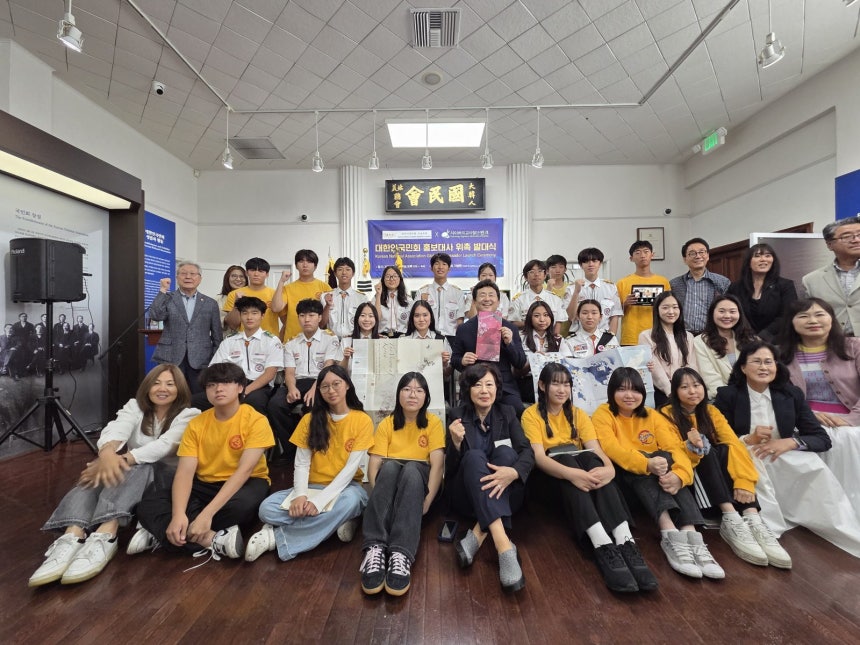
Voluntary Agency Network of Korea, led by Park Gi-tae, and the Korean National Association Memorial Foundation, chaired by Jennifer Choi, held an inauguration ceremony for the “Global Korean National Association Ambassadors” on March 29, 2026 (local time) at the Korean National Association Memorial Hall in Los Angeles, California, USA.
The ceremony was organized to carry forward the historical significance of the Korean National Association, which united Korean communities in the United States more than a century ago for the country’s independence, and to reinterpret its legacy in the language of 21st-century youth for a global audience.
The event was held in a hybrid format, both online and offline, with around 100 participants attending in person and virtually.
The program began with a lecture by Park titled “Korean National Association Ambassadors: A Great Challenge.” This was followed by presentations from researchers Kwon So-young and Koo Seung-hyun, who outlined practical content creation methods and global outreach strategies under the theme of ambassador activities. In particular, they shared actionable approaches to correcting misconceptions about Korean history in global textbooks and online content using AI and digital platforms.
VANK and the Korean National Association Memorial Foundation signed a memorandum of understanding in October 2025 and have since worked together to promote the historical value of the Korean National Association and foster the next generation of global public relations talent. Founded during the loss of national sovereignty in the 1910s, the Korean National Association effectively functioned as a self-governing body for Korean immigrants in the United States, issuing identification cards and carrying out policing and judicial roles.
Notably, first-generation Korean immigrants raised funds for the independence movement through wages earned under extreme heat exceeding 40 degrees Celsius and by setting aside a spoonful of rice, known as “seongmi,” each time they prepared meals. These contributions accounted for more than 60 percent of the early finances of the Provisional Government of the Republic of Korea and have been recorded as a symbol of community solidarity and dedication.
Based on this historical background, the two organizations plan to carry forward and expand the spirit of unity and sacrifice demonstrated by early Korean immigrants through the “Global Korean National Association Ambassadors” program in ways suited to the digital age. The project, launched at the symbolic Korean National Association Memorial Hall, is expected to provide an opportunity for Korean Americans in Los Angeles to grow into global citizen diplomats who actively promote Korea’s history and values.
In his lecture, Park said, “The Korean National Association was a community that protected one another with the belief that ‘we are Korea’ even in the despair of losing the nation,” adding, “The reason we can live confidently in the world today is because of the dedication of our ancestors, who worked for both survival and independence a century ago.”
He added, “They are the roots of today’s Korean American identity and a source of pride we must carry forward,” stressing the need to reexamine the lives of individual independence activists and ensure their spirit continues through the actions of younger generations.
Park also introduced the life of independence activist Kim Jong-rim (1886–1973), drawing strong resonance from the audience. “Kim achieved great success in rice farming under harsh conditions in California 100 years ago and became the first Korean American millionaire, but he willingly gave up his wealth for the independence of his homeland,” Park said.
He added, “Those of us living in California today must not leave this story as a tale of the past,” emphasizing that “we must carry on the nation preserved by our ancestors’ ‘one spoonful of rice’ and become 21st-century independence activists who promote Korea to the world.”
In her presentation, Kwon said that while traditional diplomacy in the past relied on one-way communication through official government channels, it must now evolve into “21st-century digital public diplomacy,” where citizens and students actively participate and exert influence through digital platforms.
As an example, she introduced VANK’s campaigns that shed new light on the history of the Korean independence movement in the United States. These include digital content highlighting the lives of independence activist Kang Hye-won, a pioneer of women’s independence efforts; Lee Dae-wi, who represented Korean Americans; and Song Heon-ju, who worked on the diplomatic front, including as an interpreter for the Hague mission and participation in international conferences.
She also outlined key principles for producing historical and cultural content: interactivity that encourages audience participation, a strategic approach that expands the concept of information, and tailored storytelling that presents content in ways audiences can understand. Kwon added that when digital content based on these principles spreads, the history and spirit of Korea’s independence movement can become shared universal values among global citizens.
Koo, meanwhile, explained how to identify and correct errors and distortions related to Korea. He noted that in many overseas museums and galleries, Korean history is still misrepresented as part of Japan or China, or errors such as the exclusive use of the term “Sea of Japan” remain uncorrected.
A survey of institutions in Texas, including the Dallas Museum of Art and the Crow Museum of Asian Art, showed that Korean exhibits were significantly smaller than those of Japan and China or contained inaccuracies in descriptions, reflecting the broader issue of Korea being insufficiently represented worldwide.
He shared a case in which, rather than merely pointing out errors, he sent a polite and logical letter to a museum that led to the correction of the term “East Sea.” He emphasized that the process of identifying and correcting such errors is itself a powerful form of public diplomacy and explained in detail the structure of his written request.
He also highlighted that in the age of AI, anyone can use generative AI to draft persuasive letters in English and take part in global campaigns.
Jennifer Choi, chair of the Korean National Association Memorial Foundation, said, “The experience of overseas Koreans voluntarily creating order and institutions to protect their community during times of national crisis is a valuable legacy that must continue today.” She added that the issuance of identification cards, the operation of policing and judicial functions, and voluntary fundraising through “seongmi” represent a living heritage that combines community spirit with action. “This K-public heritage is not just a historical record but a global public value to be shared and expanded by present and future generations,” she said.
Clara Won, head of future policy at the foundation, said, “This ambassador program is significant in that it reinterprets the spirit of the Korean National Association in the language of the digital age and enables Korean youth to actively participate in delivering it,” expressing hope that these values will connect with and spread among global citizens beyond regions and generations.
Following the launch ceremony, participants will carry out a four-stage mission over about a month. The first stage focuses on building interest through lectures and video content about the Korean National Association and independence activists, along with reflections and learning materials. The second stage involves investigating and correcting errors related to Korea in U.S. textbooks, maps, museums, and websites, as well as identifying inaccuracies in generative AI data. The third stage centers on producing and sharing digital content on Korean history and culture using AI and global networks. The final stage requires participants to design and implement their own projects as ambassadors, including creative initiatives such as proposing online exhibitions using global platforms.
All completed missions will be evaluated by VANK and the Korean National Association Memorial Foundation, and outstanding participants will be awarded official certificates as “Korean National Association Ambassadors.”