
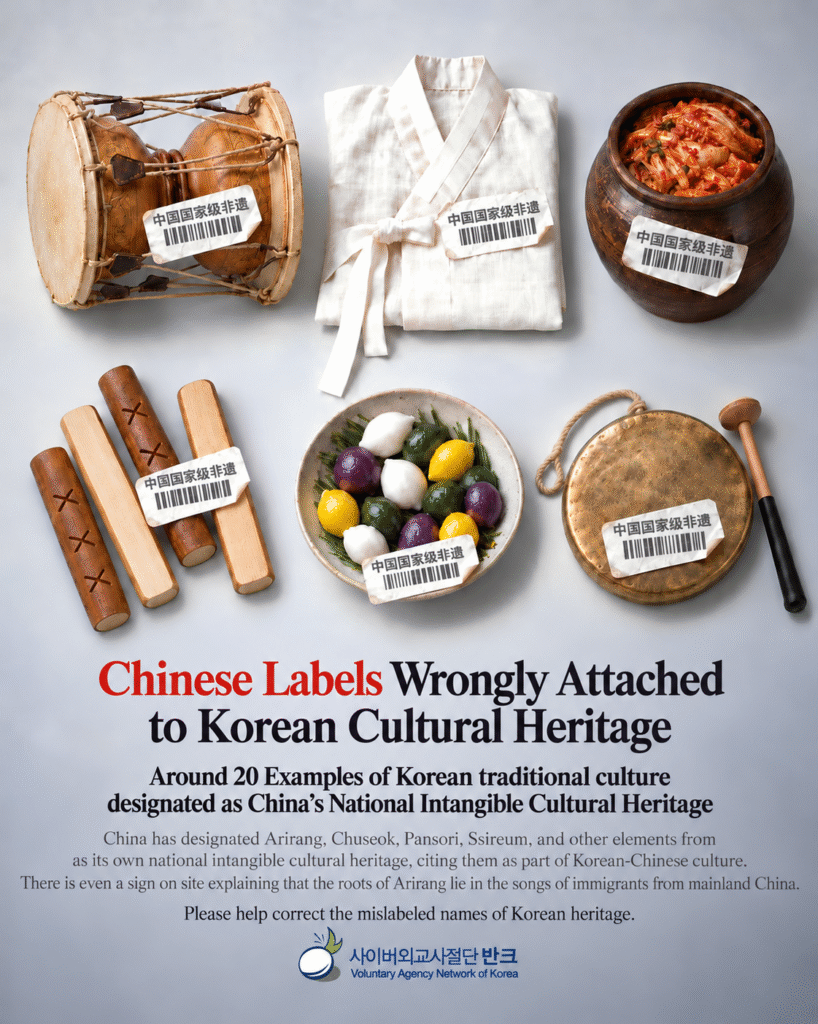
Cyber Diplomacy Organization VANK has launched a campaign to raise international awareness of the historical origins of Korean cultural heritage following China’s designation of more than 20 traditional cultural elements associated with the Korean minority as national-level intangible cultural heritage.
VANK announced on October 16, 2026, the launch of its “Chinese Labels Wrongly Attached to Our Heritage” campaign, which aims to move beyond protests over alleged historical and cultural distortions and strengthen efforts to promote Korean culture overseas.
The campaign draws on a comprehensive study titled “Comprehensive Research on China’s Cultural Engineering Regarding Korean Traditions,” conducted by the Korea Heritage Service.
According to the study, China’s three northeastern provinces—Jilin, Liaoning and Heilongjiang—have designated approximately 20 traditional cultural elements associated with the Korean minority as national-level intangible cultural heritage, including duplicate entries. The list dates back to 2006, when Nongak, a traditional Korean music and dance performance, was designated, and includes Arirang, the gayageum, pansori, ssireum, kimchi-making and Chuseok.
Kimchi-making is listed as “Korean Ethnic Minority Pao Cai Production Techniques,” while Chuseok is registered as “Korean Ethnic Minority Chuseok Festival,” a category under China’s Mid-Autumn Festival.
The study also identified local explanations of cultural heritage origins that differ from historical accounts on the Korean Peninsula. An information board at an exhibition facility in Heilongjiang Province, for example, claims that songs sung by migrants who crossed from the mainland to the Korean Peninsula after the Han Dynasty established the Four Han Commanderies served as the prototype for Arirang.
The report also found that some cultural elements included on China’s national-level intangible cultural heritage list, such as tungso music, the haegeum and neolttwigi, have not yet been designated as national cultural heritage in Korea.
To draw attention to the issue, VANK has produced campaign posters depicting Chinese intangible cultural heritage labels attached to traditional Korean items, including the janggu drum, hanbok jeogori jacket, kimchi storage jars, yut sticks, songpyeon rice cakes and jing gongs. The images are intended to highlight how cultural traditions passed down on the Korean Peninsula can be labeled under another country’s heritage system.
As part of the campaign, VANK plans to produce multilingual informational graphics and short videos explaining the historical backgrounds of the cultural elements and distribute them through social media and other channels. It will also identify cases in which Korean cultural heritage is incorrectly presented as Chinese culture in overseas encyclopedias, travel websites and generative artificial intelligence (AI) platforms, and request that the errors be corrected.
VANK also plans to recommend that the government regularly review the study’s findings, consider designating cultural elements not yet recognized as national heritage in Korea, and raise concerns through diplomatic channels over inaccurate descriptions in overseas materials.
In addition, the organization will develop multilingual promotional materials to help foreign residents in South Korea, including international students and immigrants, learn about and experience Korean traditions such as Arirang, Chuseok and kimchi.
“China is taking the lead in promoting related cultural heritage to the international community as its own culture through national-level designations and UNESCO inscriptions,” Park Gi-tae, head of VANK, said. “Since protests on a case-by-case basis have their limitations, the most powerful countermeasure is to promote Korean culture more broadly and accurately to the world.”