
VANK said Sept. 24, 2026, that it will launch a global campaign calling for the full history of the forced mobilization of Koreans to be reflected in Japan’s efforts to have the Ashio Copper Mine in Tochigi Prefecture inscribed as a UNESCO World Heritage Site.
The campaign is aimed at putting the brakes on Japan’s push to have the Ashio Mine inscribed as a World Heritage Site without fully reflecting its history of forced mobilization.
From August 1940 to May 1945, 2,416 Koreans were forcibly mobilized to the Ashio Copper Mine, where 73 people died.
Twenty-two of those who died were infants under 1 year old, while 257 Chinese workers and Allied prisoners of war were also subjected to harsh labor.
Nikko City has been seeking World Heritage status for the mine since 2007, but the history of the forced mobilization of Koreans is not mentioned at any of the related memorial museums or other facilities.
Concerns have grown in particular after Kato Koko, director of the Industrial Heritage Information Center, who led efforts to secure World Heritage status for Hashima Island and the Sado Island Gold Mines, identified the Ashio Mine as the “next heritage site” Japan plans to pursue for World Heritage inscription.
VANK describes the latest move as a repetition of what it calls the “erasure of history” seen in the cases of Hashima Island and the Sado Island Gold Mines.
Japan pledged during the previous two World Heritage inscription processes to reflect the history of forced mobilization, but has since faced criticism that it failed to honor its commitments to the international community through distorted exhibitions at the information center and the holding of what was criticized as an incomplete commemorative ceremony.
In response, VANK plans to move away from its previous approach of calling for Japan to honor its commitments only after a site has been inscribed and instead take proactive action before the Ashio Mine is formally added to the UNESCO Tentative List.
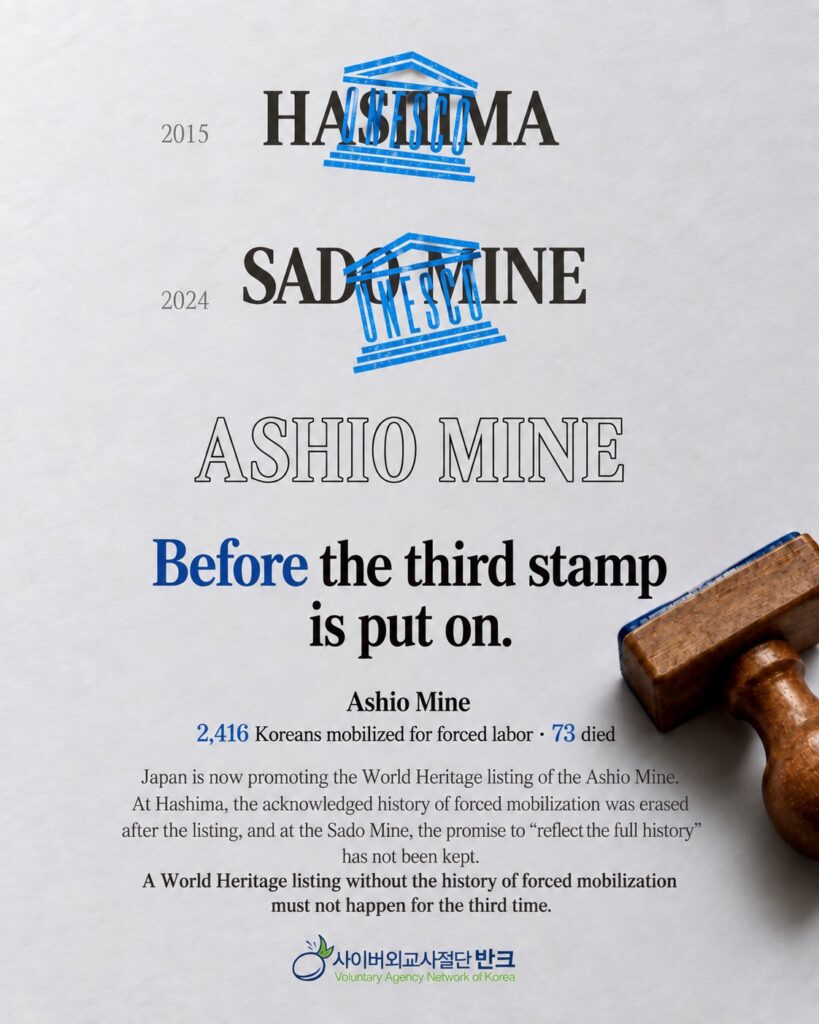
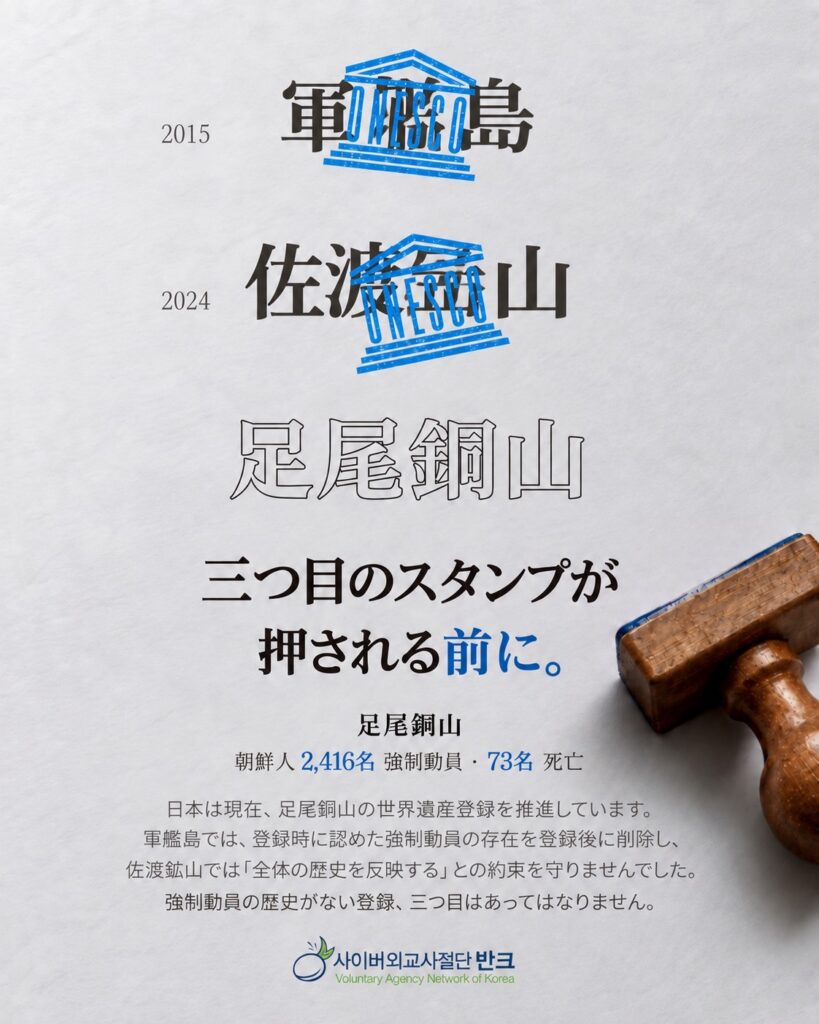
To that end, VANK has produced and distributed English- and Japanese-language posters titled “Before the third stamp is put on” and posted a petition on its own global petition platform, “Woollim.”
The posters depict Hashima Island and the Sado Island Gold Mines with UNESCO “inscription stamps” already marked on them, alongside the Ashio Mine, which has yet to receive one, underscoring the urgency of taking action in advance.
VANK plans to produce infographic content and short-form videos explaining the history of forced mobilization and promote them on social media. It will also continue monitoring materials related to the inscription effort and official promotional materials and calling for corrections where necessary.
The organization also plans to expand public participation by using its own AI platforms, including “AI Legislator” and “AI Secretaries-General,” to create a forum where citizens can directly propose and discuss related policies.
Park Gi-tae, head of VANK, said, “We must not leave out the history of the people who suffered at these sites while telling the world about the achievements of industrial development. Together with young people and citizens, we will strongly call on the international community to ensure that this history is properly reflected.”