
Some Spanish history and geography textbooks contain significant errors and omissions in their coverage of Korean history, including accounts that place Japan’s domination of the Korean Peninsula as much as 15 years earlier than it actually began, a South Korean civic diplomacy organization said Wednesday.
VANK said Sept. 2, 2026, that it had reviewed seven middle and high school history and geography textbooks published by five major Spanish publishers — Santillana, ANAYA, Vicens Vives, Akal and Casals — and identified inaccuracies and imbalances in their coverage of Korea. The organization sent each publisher a report detailing its findings along with letters requesting corrections.
It was VANK’s first systematic review of Korean history coverage in Spanish-language textbooks.
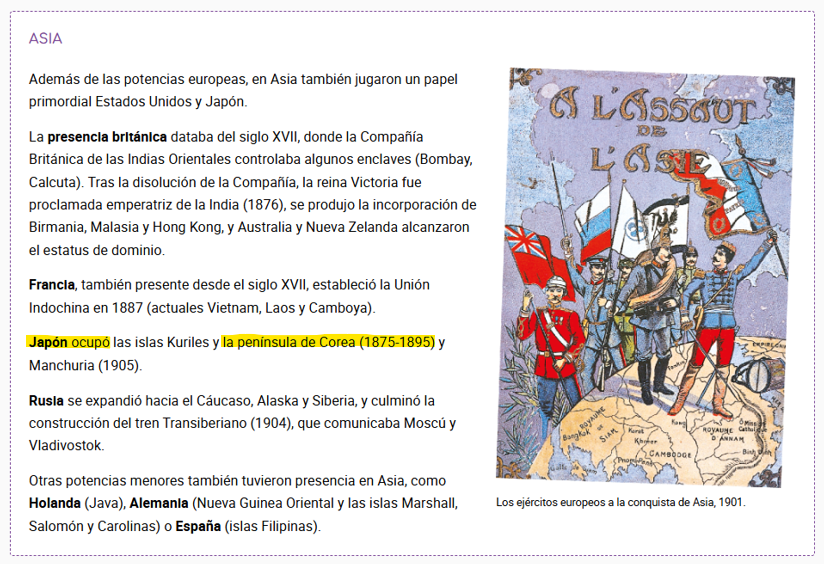
One of the most notable problems involved the timing of Japan’s control over the Korean Peninsula. World history textbooks published by ANAYA and Vicens Vives state that Japan occupied the entire Korean Peninsula between 1875 and 1895.
Japan actually stripped Korea of its diplomatic sovereignty through the 1905 Eulsa Treaty and formally annexed Korea in 1910. The Korean Empire was established in 1897. VANK said the textbook accounts effectively erase the period in which the Korean Empire existed and place the loss of Korean sovereignty at least 15 years earlier than the historical record indicates.
An Akal textbook describes the 1895 Treaty of Shimonoseki as an agreement that confirmed Japan’s rule over Korea. VANK said this reverses the historical context of the treaty, under which China recognized Korea’s full independence and autonomy rather than granting recognition to Japanese rule over Korea.
Another concern was the use of wording that could obscure the nature of Japan’s colonial rule. A Santillana textbook states that “Korea was part of the Japanese Empire before World War II,” but does not adequately explain the process through which Korea was forcibly brought under Japanese colonial rule, including the 1905 treaty and the 1910 annexation, or the resistance movements that followed, VANK said.
The organization also found that coverage of the Korean War tended to focus on the involvement of outside powers, including the United States, Soviet Union, China and the United Nations, while giving less attention to the role of South Korean forces and the suffering of Korean society. The establishment of separate governments in South and North Korea in 1948 was also omitted from many of the textbooks’ sections on Korea.
Not all of the textbooks were problematic. Some distinguished between the 1905 treaty that made Korea a Japanese protectorate and the 1910 annexation, and accurately identified 1948 as the year separate governments were established in South and North Korea. Most of the maps examined by VANK also used both “Sea of Japan” and “East Sea.”
Vicens Vives responded to VANK’s findings by saying it had shared the information with its editorial team and would consider incorporating the changes into future printed editions, according to VANK.
Park Gi-tae, head of VANK, said that how a country’s history is taught in classrooms around the world can shape perceptions of that country.
“Knowing how Korean history is conveyed in classrooms across different countries is the starting point for understanding how Korea is perceived,” Park said, adding that VANK would continue efforts to identify and correct inaccuracies in Korean history textbooks in different languages.
Lee Sei-yeon, a VANK youth researcher, said that Korea “essentially appears in the Spanish-language textbooks only through colonial rule and war,” arguing that correcting historical errors should go hand in hand with expanding the coverage of Korea’s history from a broader and more independent perspective.