
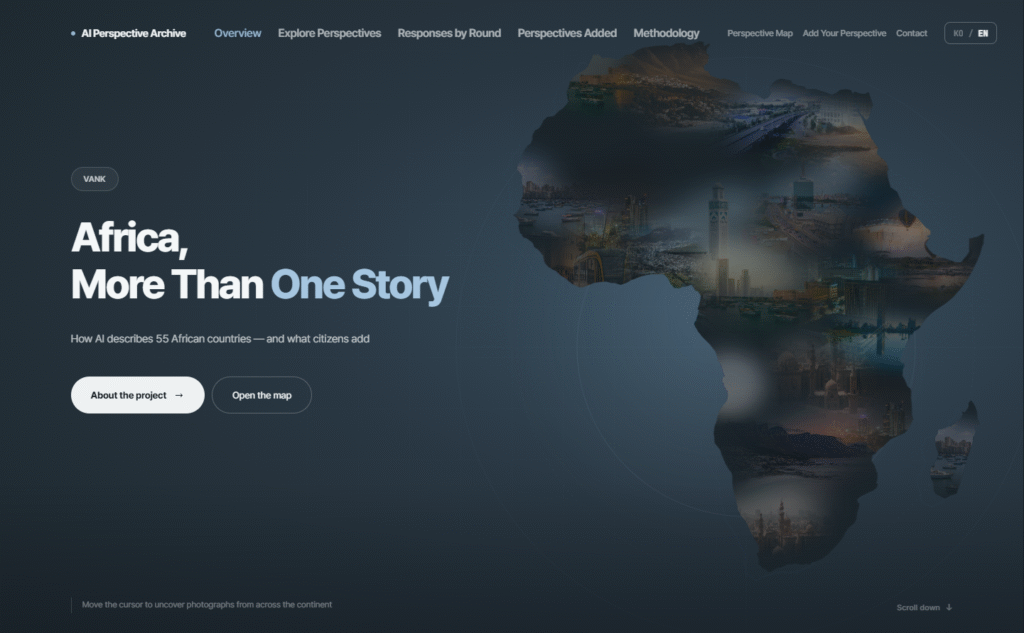
VANK launched an online platform on Sept. 1, 2026, that tracks and analyzes the information and perspectives generative artificial intelligence uses to portray Africa’s 55 countries.
The “AI Perspective Archive” (africaview.one) examines which images and pieces of information repeatedly emerge when AI is asked the same questions about a country, as well as which aspects remain largely absent. The platform is designed to identify patterns in how generative AI represents individual countries.
The platform expands on the “AI Representation Observatory of Africa’s 55 Countries,” (www.prkorea.com/action1.html) an online platform launched in July to analyze the frames and images AI uses when describing African countries.
VANK asked ChatGPT and Gemini to list five things that came to mind when presented with the names of all 55 member states of the African Union (AU), with the questions posed in both Korean and English.
From July 14 to Aug. 27, 2026, VANK collected 11,000 AI responses through 50 rounds of queries. The five items provided in each response were then individually categorized, resulting in a total of 55,000 pieces of “perspective data.”
The data was classified into 15 categories: poverty and deprivation; conflict and insecurity; wildlife and nature; traditions and customs; colonialism and its legacy; independence and resistance; civilization and heritage; politics and power; economy and resources; technology and innovation; cities and modernity; education and youth; diplomacy and international affairs; culture and the arts; and geopolitics and location.
Wildlife and nature dominated AI’s portrayal of Africa
“Wildlife and nature” accounted for the largest share of the responses, at 32.2%.
For Kenya, Chad, the Republic of the Congo, Tanzania, Zambia, Zimbabwe, Botswana, Namibia, South Africa and Madagascar, “wildlife and nature” consistently emerged as the dominant perspective across all 50 rounds of queries.
VANK said the findings do not mean that these countries are simply nature-centered societies. Rather, they show which images AI tends to call up first when it encounters a country’s name and which aspects of their realities are comparatively pushed into the background.
In the case of Gabon, a country in Central Africa, AI repeatedly produced explanations of “gabon” (假縫), a term referring to temporary stitching in clothing production, rather than information about the country when asked in Korean. Of the responses collected across 50 rounds, 23.7%, or 237 responses, were found to be unrelated to the country.
VANK attributed the confusion to the fact that the Korean spelling of the country’s name is identical to the Korean term for temporary stitching.
The analysis also identified individual factual errors, an overreliance on particular perspectives, disparities in the information provided in Korean and English, and a tendency for similar answers to persist even after repeated queries.
Platform allows users to explore AI’s ‘perspectives’
The AI Perspective Archive visualizes the findings so users can explore them directly.
By selecting any of Africa’s 55 countries, users can view the distribution of perspectives, changes in the dominant perspective over time, the diversity of perspectives, differences between ChatGPT and Gemini, disparities between Korean- and English-language responses, and the proportion of responses unrelated to the country.
The platform also makes the original AI-generated responses available by date and round, allowing anyone to examine the answers on which the analysis was based.
In particular, the archive was designed to allow citizens to contribute aspects of Africa that AI may have overlooked.
Through the platform’s participation section, anyone can select one of the 55 African countries and choose a topic—wildlife and nature; traditions and customs; civilization and heritage; economy and resources; technology and innovation; cities and modernity; education and youth; or culture and the arts—and add a keyword and a one-line story based on what they know. No registration or login is required.
The stories contributed by citizens can then be viewed alongside the perspectives generated by AI.
VANK said the platform aims to go beyond simply pointing out AI bias and instead serve as an open digital archive where people around the world can collectively build a richer and more diverse picture of Africa.
“An incorrect answer from generative AI may be a mistake, but when the same perspective is repeated dozens of times, it becomes a structural issue that we need to examine together,” Park Gi-tae, head of VANK, said. “In the AI era, an important measure of technological progress should go beyond the speed and performance of AI models to include how accurately and comprehensively they represent different regions and cultures around the world.”
Lee Sei-yeon, a VANK youth researcher who developed the platform, said the project begins by examining what AI says about Africa, but that people’s experiences and stories will ultimately make the archive richer.
“If you know about African cities and young people, technology and culture, or simply the everyday lives that AI has yet to discover, we invite you to add your own line,” Lee said.