
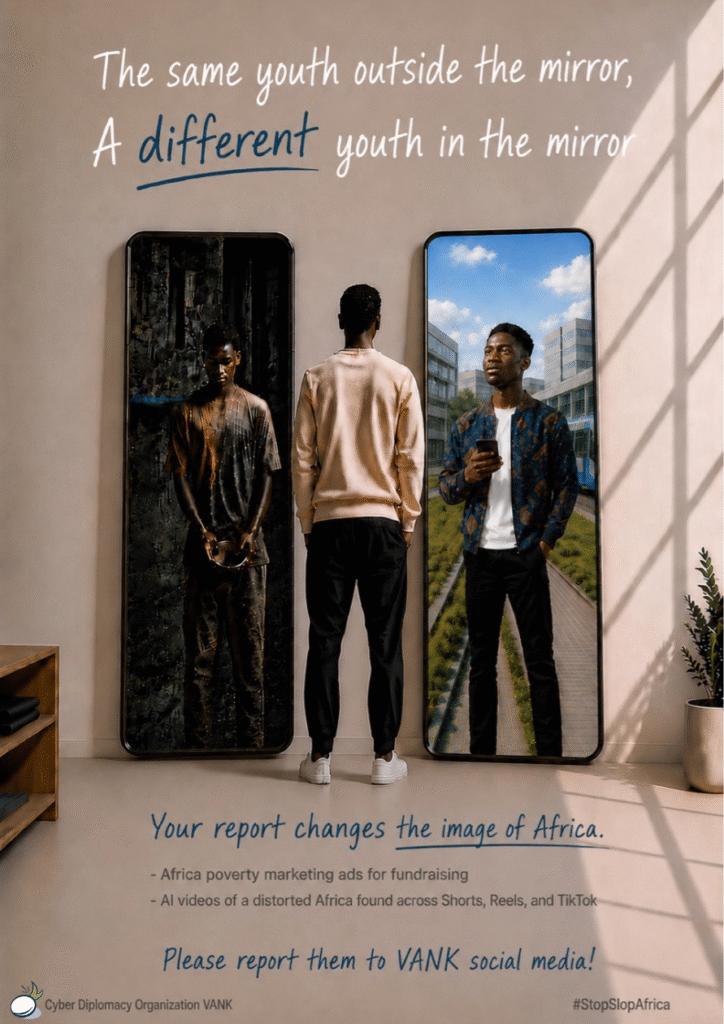
VANK, a Korean cyber diplomacy organization, has launched a global campaign aimed at combating exploitative poverty marketing and low-quality, AI-generated content that it says is spreading distorted and damaging images of Africa across social media.
The campaign, announced on Aug. 21, 2026, targets what VANK describes as “poverty porn” and “AI slop” — fabricated or sensational AI-generated videos designed primarily to attract clicks, views and advertising revenue.
Under the slogan, “The Same Youth Outside the Mirror, A Different Youth In the Mirror,” VANK is calling on internet users around the world to report misleading content about Africa and help challenge stereotypes that portray the continent primarily through images of poverty, disease, conflict and helplessness.
The campaign comes amid the rapid spread of AI-generated videos on platforms such as YouTube, TikTok and Instagram. Some of the videos depict fabricated scenes of African people eating mud cakes alongside wild animals or living in bizarre and extreme conditions. Created using generative AI, such content is often designed to generate views and engagement despite having little or no connection to reality.
VANK said the problem extends beyond AI-generated misinformation. For decades, images emphasizing extreme hunger, disease and suffering have also been used in fundraising campaigns, a practice often criticized as poverty marketing or “poverty porn.”
According to VANK, both forms of content can reduce Africa’s 54 countries and its population of more than 1.4 billion people to a single image of poverty and dependency.
Beyond Stereotypes: The Cost of a Distorted Image
VANK argues that such representations can have consequences beyond the digital space.
By repeatedly portraying Africa as an unstable continent dependent on outside aid, distorted content can contribute to what the organization describes as an “Africa discount” — negative perceptions that may discourage foreign direct investment, business partnerships and broader economic engagement.
The organization also warned that young Africans working at the forefront of technological innovation could face stereotypes before their skills are even evaluated. It cited examples such as Nigeria’s fintech sector, Kenya’s mobile financial services and Rwanda’s drone logistics industry.
VANK further expressed concern that fabricated AI-generated content could eventually become part of the data used to train future AI systems, reinforcing racial and cultural biases and allowing distorted representations of Africa to become embedded in the digital ecosystem.
“The problem is not reality, but the manipulated frame,” the organization said in explaining the message behind the campaign.
The campaign poster contrasts the image of a real young person outside a mirror with two distorted reflections inside it — one shaped by poverty marketing and the other by sensational AI-generated content.
Citizens Asked to Report Distorted Content
VANK is inviting internet users to submit links and screenshots of sensational fundraising advertisements that exploit images of poverty, as well as bizarre or misleading AI-generated videos created to attract views on social media.
Participants can report such content through VANK’s official social media channels using the hashtags #StopSlopAfrica and #RealAfrica.
Based on the information collected, VANK plans to call on major domestic and international fundraising organizations, as well as global technology companies including Google, Meta and TikTok, to strengthen algorithmic filtering and require clearer labeling of AI-generated content.
The organization said it also intends to move the issue beyond online criticism and pursue policy and institutional changes at both the international and domestic levels.
Through its global policy participation platform, “We are the AI Secretaries-General of an International Organization,” VANK plans to encourage international discussion of measures to combat exploitative poverty marketing and AI-generated misinformation about Africa, with the goal of bringing the issue into discussions surrounding possible UN resolutions.
At the domestic level, VANK plans to use its “I am the AI Lawmaker” public legislative participation platform to share its findings with Korean lawmakers involved in foreign affairs and education and advocate for the issue to be reflected in global citizenship education policies and legislation.
Kwon So-young, a researcher at VANK who is leading the campaign, said the organization aims to ensure that citizens’ concerns lead to concrete institutional action.
“We want to go beyond simply identifying and correcting problems online,” she said. “Through VANK’s platforms, we hope to turn the voices of citizens into tangible institutional outcomes, including the discussion of a UN resolution and legislative action in the National Assembly of Korea.”
She added that the campaign would also raise questions about the social responsibility of global technology companies and the need to incorporate the issue into international standards and global citizenship education.
Ma Ji-yun, a youth researcher at VANK, said AI-generated misinformation and poverty marketing spreading through social media algorithms were reinforcing stereotypes among young people around the world.
“We hope internet users everywhere will become monitors and fact-checkers, reporting distorted content and joining a global civic movement to share the real value and diversity of Africa’s 54 countries,” she said.
Lee Hyun-woo, another youth researcher, said a sensational fake video might appear to be nothing more than a harmless click to some viewers but could become “an invisible barrier” limiting future opportunities for Africa and its young people.
“Distorted content can have real consequences,” he said. “We hope this campaign will become a starting point for challenging irresponsible algorithmic practices and restoring cultural diversity and inclusion in the digital space.”
Park Gi-tae, head of VANK, compared the issue to Korea’s own experience with negative perceptions of the country.
“South Korea once experienced what was known as the ‘Korea discount,’ when the country’s image and products were undervalued because it was trapped in the dark frame of colonial rule and war,” Park said.
“Now, we believe Korea should stand in solidarity with Africa, which faces similar challenges from an ‘Africa discount,’” he said. “Africa is a continent of the future, where dynamic IT innovation and startups are flourishing, yet this reality is often obscured by content driven by algorithmic profits and appeals to pity.”
VANK said the campaign ultimately seeks to replace distorted images of Africa with a more accurate understanding of the continent’s diversity, capabilities and future potential.
By encouraging citizens around the world to identify misleading content and by pursuing action from technology companies, policymakers and international institutions, the organization hopes to turn public participation into a broader effort to challenge digital stereotypes and ensure that Africa is represented on its own terms.