
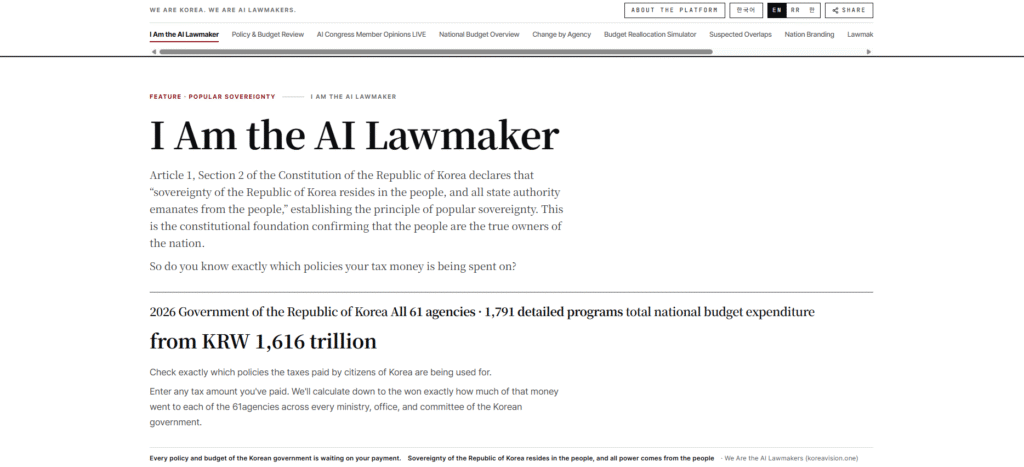
VANK has launched an AI-powered financial platform designed to allow ordinary citizens and overseas Koreans to examine and evaluate the government’s massive national budget, promoting a new model of public participation in policymaking.
VANK, led by Chairman Park Ki-tae, unveiled the platform, titled I Am an AI Lawmaker — A Fiscal Map for an Era of Popular Sovereignty, on Aug. 10, 2026. The platform allows users to trace government spending down to the won and assess individual government programs using public data and generative artificial intelligence.
The initiative expands VANK’s efforts since 1999 to train young people as private “digital diplomats” and “AI diplomats.” The organization said it now aims to develop young people and the broader public into “AI lawmakers” who can directly examine government policies and budgets.
VANK said the project was conceived in response to the practical limits of having roughly 300 lawmakers review and evaluate the government’s entire budget, which totals about 1,615 trillion won. By making complex budget information easier to understand, the platform seeks to broaden public participation in fiscal policymaking.
The project is also based on the principle of popular sovereignty enshrined in Article 1, Clause 2 of South Korea’s Constitution, which states that sovereignty resides with the people and that all state authority comes from the people.
61 agencies and 1,791 programs at citizens’ fingertips
The platform is based on the government’s official 2026 expenditure budget data and provides information on 61 central government agencies and 1,791 individual programs.
Rather than simply displaying program names and budget amounts, it incorporates an “AI legislative aide” that summarizes each program’s purpose, beneficiaries, performance indicators, key issues and points requiring attention.
For example, users examining the Ministry of Foreign Affairs’ development cooperation and humanitarian assistance programs can see summaries explaining their role in emergency relief in disaster and conflict zones and support for developing countries, along with information on beneficiaries, performance indicators and issues that may warrant scrutiny.
The platform also offers a feature called “My Tax Receipt,” which estimates how an individual’s tax contribution is distributed across government agencies. Users can trace the flow of government funds, compare agencies’ budget changes from 2024 to 2026 and examine year-on-year changes.
An AI-based function can also identify programs across different ministries that appear to have similar or potentially overlapping purposes, allowing users to examine possible duplication and the efficiency of government spending.
Citizens can turn the “fiscal traffic light”
The platform’s central feature is its system for direct public participation.
After reviewing an AI-generated summary of a government program, users can cast a “Fiscal Traffic Light” vote, selecting whether the program is appropriate, should be maintained, or should be reorganized.
The results and suggestions submitted by citizens are displayed in real time through an “AI Lawmaker Opinions LIVE” system. Users can also review the legislative activities and contact information of lawmakers serving on the relevant National Assembly committees and submit their assessments directly.
VANK has also created dedicated functions for examining spending related to areas closely tied to Korea’s international standing, including public diplomacy, support for Korean cultural content, Korean-language promotion, overseas Koreans and tourism.
Focus on 7.08 million overseas Koreans
The platform places particular emphasis on South Korea’s estimated 7.08 million overseas Koreans, whom VANK describes as a key pillar of the country’s global network and international standing.
VANK said government spending related to overseas Koreans amounts to roughly 112.7 billion won, a relatively small share of the national budget compared with the size and contribution of the overseas Korean community.
The organization said the platform will enable overseas Koreans, as well as citizens in South Korea, to examine how funds related to overseas Koreans are allocated and spent. AI tools can also identify similar programs spread across multiple ministries, helping users assess whether resources are being allocated efficiently.
VANK said combining the global network of overseas Koreans with the country’s growing global cultural influence could strengthen Korea’s position as a leading advanced nation.
“Rather than leaving the evaluation of 1,615 trillion won worth of government programs to roughly 300 lawmakers, we want all 50 million citizens and 7.08 million overseas Koreans to become ‘AI lawmakers’ who directly verify and evaluate national budgets and policies,” Park said.
VANK seeks to make sovereignty a daily practice
Park said VANK’s experience training young people as digital and AI diplomats had led the organization to broaden its focus from international public diplomacy to domestic policy participation.
“Since VANK was founded in 1999, we have trained young people as private digital diplomats and AI diplomats because we recognized that roughly 3,000 official personnel at the Foreign Ministry alone could not effectively introduce Korea to 8 billion people around the world,” Park said.
“Now we want to take the next step and develop Korea’s young people and the entire population into ‘AI lawmakers.'”
Park emphasized that popular sovereignty should not be viewed as a right exercised only on election day.
“Popular sovereignty is not a one-time right exercised only once every four or five years on election day,” he said. “It can also be realized in everyday life by examining and monitoring the budget that is implemented every year.”
He said VANK hopes greater public interest and participation will help improve the quality and competitiveness of national policies.
Open access and plans for further analysis
The platform is available without registration to Korean citizens and overseas Koreans. Users can view public feedback and voting results in real time, while original budget data and major analytical reports are available through the platform’s source section.
VANK plans to use data gathered through public participation to regularly publish reports analyzing potentially duplicated programs, questionable spending and other issues surrounding government budget allocation and implementation.
The organization also plans to deliver relevant findings to National Assembly standing committees during the annual budget review process, turning citizen feedback into a resource for parliamentary scrutiny.
Through the platform, VANK said it hopes to move national budget review beyond the confines of lawmakers and specialists and into a broader public forum in which citizens can use AI and public data to exercise their constitutional role as the ultimate holders of sovereignty.