
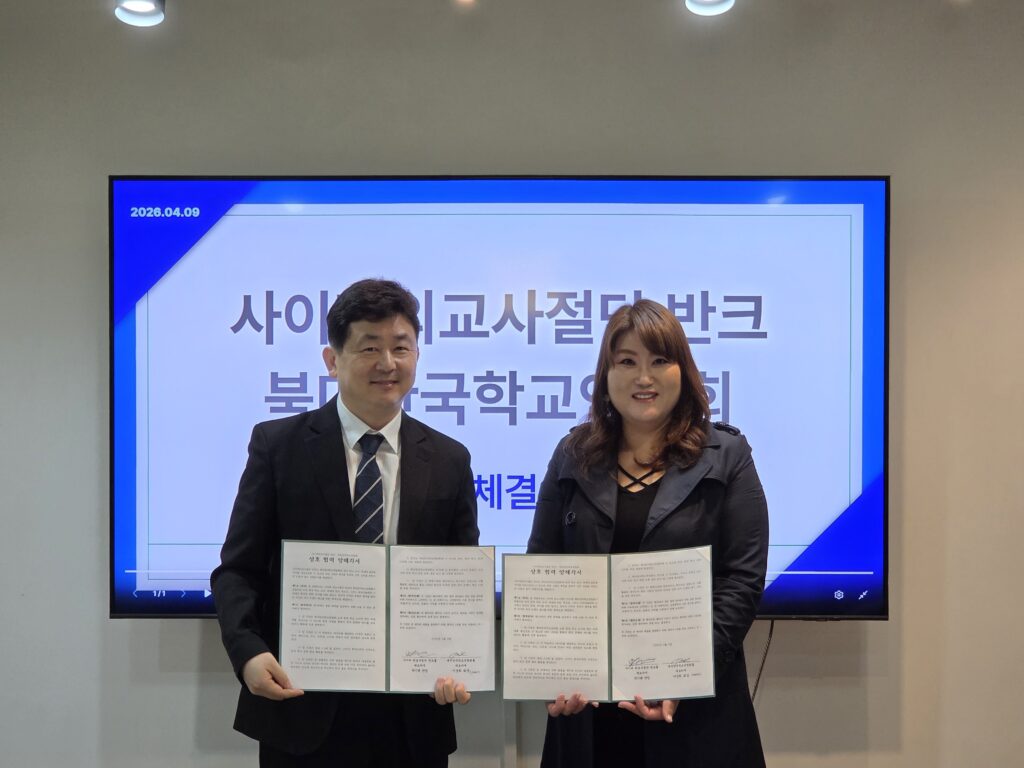
The Voluntary Agency Network of Korea (VANK), led by Director Park Gi-tae, announced that it has signed a memorandum of understanding (MOU) with the Korean School Association of the United States (KSA-US), headed by President Lee Sang-hee, to train Korean school teachers and next-generation Korean American youth across North America as “AI diplomats” who will help strengthen friendship and cooperation between the Republic of Korea and the United States in the 21st century and elevate the national brands of both countries.
The signing ceremony took place on April 9, 2026, at VANK’s office in Seoul, with Vice President Kwak Eun-ah attending on behalf of KSA-US President Lee Sang-hee.
The agreement comes at a time when global interest in South Korea has reached unprecedented levels, with the number of Hallyu fans worldwide surpassing 200 million. However, behind this growing popularity lies a serious challenge: generative AI, a powerful new repository of human knowledge, still contains significant distortions of Korea’s history and cultural heritage within its training data.
In response, the two organizations agreed to closely cooperate across seven key areas, driven by a shared sense of urgency that next-generation Korean American youth growing up in North America must move beyond basic Korean language learning and become “ambassadors of Korea” who can defend the truth about their heritage against errors in the age of artificial intelligence.
At the core of the MOU is the goal of “cleaning AI training data.” The two sides plan to conduct detailed reviews and carry out strong corrective actions to ensure that information about Korea is accurately represented in U.S. elementary, middle, and high school textbooks, as well as in encyclopedias, international media, the internet, and social media platforms—key sources from which AI systems learn. The initiative is framed as a “21st-century digital independence movement,” drawing inspiration from Korean independence activists in the United States 117 years ago, who devoted themselves to their homeland’s independence. Today, instead of weapons, participants are expected to take up smartphones and prompts in what VANK describes as a new form of struggle.
The partnership will also launch creative and innovative global campaigns aimed at expanding the current Hallyu wave—largely centered on popular culture—into a deeper appreciation of Korea’s long history and rich cultural heritage. The effort seeks to engage not only second- and third-generation Korean diaspora communities, but also adoptees reconnecting with their roots and local individuals who have a genuine interest in Korea, all while strengthening bilateral ties and enhancing national branding for both countries.
Under the agreement, VANK will provide KSA-US with advanced AI diplomat training programs and in-depth digital resources on Korean history and culture. In turn, KSA-US will work to strengthen the capabilities of teachers and Korean American youth in line with the AI era and carry out Korea promotion activities tailored to the local environment in the United States.
Park Gi-tae, head of VANK, said, “Just as Korean Americans in the United States laid the noble foundation for Korea’s independence 117 years ago by setting aside a spoonful of rice at every meal, the next generation of leaders in North America will now rise as great ‘AI diplomats,’ using advanced AI prompts as their tools to properly introduce Korea to the world in the digital age.” He added, “This meaningful journey will go beyond strengthening Korea-U.S. friendship and become a defining moment in branding Korea as a dynamic country that shares dreams and friendship with people around the world, standing at the heart of Asia and as a gateway to Northeast Asia.”
Lee Sang-hee, president of KSA-US, also expressed thoughts, saying, “I am deeply moved that teachers and the next generation in Korean schools across North America now have the opportunity to serve as proud ambassadors of Korea in the new AI-driven era. With the powerful tool of AI, we will become active participants in history by sharing the true image of Korea with the world.” Lee added, “Through our strong partnership with VANK, I sincerely hope that Korean American youth will grow into global leaders with unwavering pride and deep roots, wherever they are in the world.”
Meanwhile, KSA-US, which is co-leading the initiative, officially launched after reorganizing its name on January 15, 2026, and receiving formal approval from the U.S. government on February 2, 2026. It builds on the long-standing foundation of the National Association for Korean Schools, established in 1981. The organization is a large educational network formed through horizontal collaboration among six regional associations and Korean schools across North America, dedicated to teaching the Korean language and Korean history and culture.
Its regional associations include New England, the Southwest, Northern California, Michigan, the Central-Southern region, and Hawaii. The network consists of 87 member schools, approximately 1,000 teachers, and 5,852 students.
With this landmark agreement, the two organizations aim to take a major first step in adopting innovative approaches suited to the AI era, promoting an accurate understanding of Korea, and firmly embedding the national brands of both Korea and the United States in the minds of people worldwide.
They also plan to begin recruiting “AI diplomats” among teachers in Korean schools affiliated with KSA-US, launching full-scale activities that go beyond the classroom and onto the global stage to share the truth about Korea.