
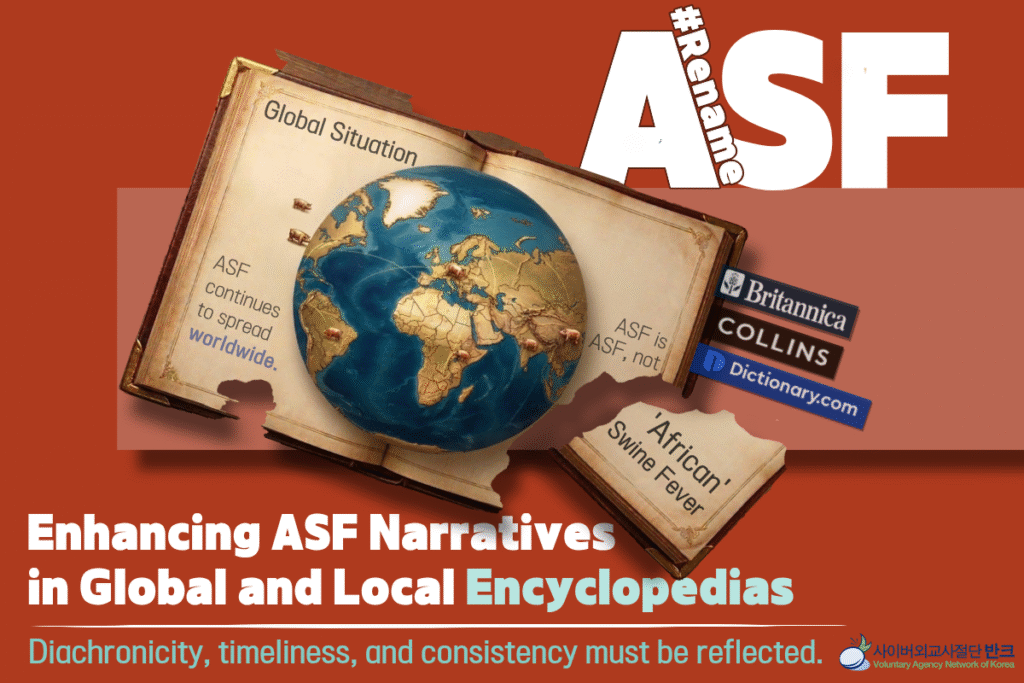
VANK has launched a campaign to replace the term “African Swine Fever (ASF)”—used by domestic and international encyclopedias and government agencies—with the neutral abbreviation “ASF,” arguing that the current name causes serious distortion and stigmatization of the African continent. The initiative also seeks to correct biased descriptions associated with the disease.
VANK has long worked to correct global inaccuracies, such as the mislabeling of “Dokdo” and the “East Sea,” while promoting Korea’s history and cultural heritage worldwide. Its efforts go beyond simply fixing errors, focusing instead on identifying and addressing biased perceptions and distortions about the world within Korean society itself.
In particular, through its recent “Africa Awareness Improvement Campaign,” VANK has pointed out that although Africa shares historical experiences with Korea, including colonial rule and discrimination, it is still portrayed in public materials through biased perspectives and misleading terminology.
In November 2025, VANK received a positive response from the Statistical, Economic and Social Research and Training Centre for Islamic Countries (SESRIC), an agency under the Organization of Islamic Cooperation (OIC), as part of its campaign to correct world maps that distort the size of Africa. The group also succeeded in revising entries on the widely used online dictionary Vocabulary.com that included terms such as “Hottentot” and “Third World,” which could reinforce negative views of Africa. Building on these precedents, VANK has continued to propose global actions to promote a fair and balanced understanding of Africa.
■ A name that creates stigma… “Africa” is not a synonym for disease
The term “African Swine Fever,” commonly used without much thought in Korea, combines with a neurological “negativity bias” to reinforce the perception of Africa as a continent defined by poverty, hunger, and disease. The World Health Organization (WHO) has already recommended in its 2015 guidelines that geographic names should not be used in disease naming to prevent stigma and discrimination.
According to the World Organisation for Animal Health (WOAH)’s monthly ASF report, Africa currently accounts for only about 5 percent of global ASF cases, with most outbreaks occurring independently in other regions. Despite this, attaching the name of an entire continent to the disease disregards Africa’s disease control efforts and reflects a form of “geographical bias” that runs counter to international standards.
■ Encyclopedias stripped of context… “Stop shifting responsibility to the place of origin”
VANK has focused on how leading global encyclopedias and dictionaries—such as Collins, Merriam-Webster, and Britannica—as well as major Korean encyclopedias and government agencies describe the disease. Most currently state only that it was “first identified in wild boars in Kenya in 1921” or that it is “endemic to sub-Saharan Africa.”
However, historical records indicate that the disease emerged when European domestic pigs introduced by settlers in the early 20th century came into contact with local wild boars. By omitting this historical context and the nature of a global pandemic, and instead emphasizing “Africa = origin,” such descriptions risk leading readers to conclude that Africa is to blame.
■ Shifting naming conventions… “ASF should be used as the primary term”
VANK is calling for immediate changes to how the disease is named in encyclopedias and public databases. It argues that the standalone use of “African Swine Fever” or the combined form “African Swine Fever (ASF)” should be replaced with “ASF” alone. Where unavoidable, the abbreviation should come first, as in “ASF (African Swine Fever).” This, the organization says, is a necessary step to minimize exposure to the word “Africa” in the disease name and prevent discriminatory perceptions.
■ In the age of AI, the spread of misinformation… terminology reform is essential
Lee Hyun-woo, a youth researcher at VANK, stressed that in the rapidly evolving AI era, algorithms often derive “correct” answers from encyclopedias and official sources. “To prevent the spread of discriminatory perceptions of Africa among students and professionals who may accept information uncritically, it is urgent to adopt the internationally standardized term ‘ASF,’” he said.
■ Removing “linguistic barriers” for successful K-ODA partnerships
As Korea seeks to strengthen partnerships with Africa through its official development assistance program (K-ODA) and position itself as a global innovation leader, eliminating discriminatory terminology is essential, VANK said. Implicit bias embedded in language can undermine mutual respect and damage the country’s national brand. Recognizing Africa not as a symbol of disease but as an equal partner in growth is therefore a critical step toward a more inclusive and sustainable future.
■ Sustaining the campaign… “One word can change the world”
VANK said the campaign will go beyond promoting the use of an abbreviation and develop into an ongoing effort to identify and correct discriminatory language about Africa embedded in everyday life. To this end, the group is urging domestic and international encyclopedias and related institutions to adopt two key revisions:
▲ Emphasize the global nature of the disease: Clearly state at the beginning of relevant sections that ASF is not confined to a specific continent but is a disease with worldwide impact.
▲ Provide fuller context of its emergence: Revise descriptions of its origin to note that it was “first reported when European domestic pigs introduced into East Africa in the early 20th century came into contact with local wild species,” thereby clarifying the historical background.
“ASF is simply ASF, not a disease of Africa,” VANK said, adding that it will continue its global advocacy efforts until socially embedded perceptions reflected in language are corrected.
Park Gi-tae, head of VANK, emphasized that “domestic and international encyclopedias and dictionaries must recognize how naming can shape thought and reinforce prejudice, and take active steps to correct such terminology.” He added, “When regional discrimination is removed from the record of knowledge, international solidarity to overcome disease can begin, bringing forward a sustainable future free from discrimination.”
Meanwhile, VANK has been raising various domestic and international issues through policy proposal platforms such as “Woollim” and “Yeollim,” as well as the global communication platform “Weform.” The current campaign also calls on both Korean and international dictionaries and encyclopedias to revise the term “African Swine Fever” through platforms including Weform.
The Weform petition can be accessed at the following link:
https://www.weformkorea.net/immediate/view.jsp?sno=2551