
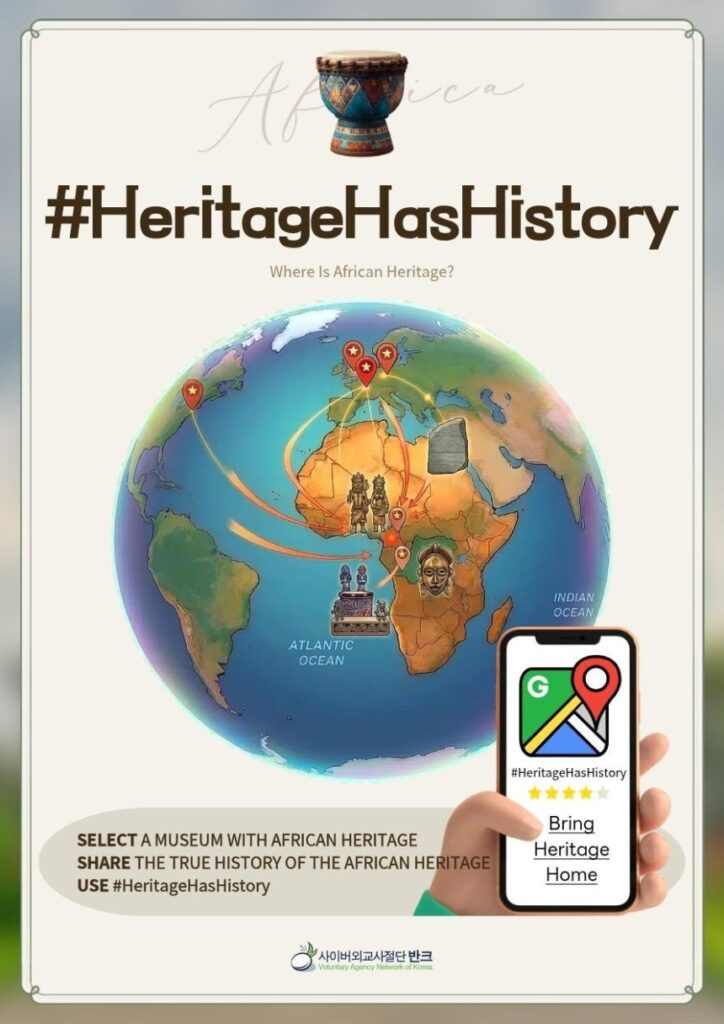
VANK, led by Park Gi-tae, announced on March 25, 2026, the launch of a global campaign calling for the restitution of African cultural heritage illegally taken during the imperial era.
The campaign, under the hashtag “#HeritageHasHistory,” aims to raise global awareness of the history of looting behind African artifacts held in Western museums and to push for full ownership transfer rather than simple long-term loans.
Today, more than 90 percent of sub-Saharan Africa’s cultural heritage is believed to be housed in Western museums. While it is difficult to determine the exact scale, an estimated 500,000 artifacts have been removed from the region. Many of these items were taken during the colonial period through looting, coercive collection, and illicit trade, highlighting how forms of cultural colonization continue to this day.
VANK describes this situation not merely as the loss of cultural property but as “memocide,” or the erasure of historical memory, warning that it weakens the identity of affected communities and calling for greater international attention.
Western museums have long taken a cautious stance on restitution, citing legal restrictions on transferring national heritage under public property laws, limited cultural preservation infrastructure in African countries, and the costs associated with transportation and conservation.
There have been some cases of return. In 2024, the British Museum and the Victoria and Albert Museum agreed to return 32 royal artifacts to Ghana. However, as the arrangement was made in the form of long-term loans rather than a transfer of ownership, it has drawn criticism as only a partial restitution.
At the same time, institutions such as the Museum of Black Civilizations in Dakar, Senegal, which opened in 2018, and the Grand Egyptian Museum (GEM), completed in 2023, are often cited as evidence that African countries now have the capacity to preserve and manage their own cultural heritage. These developments are seen as important steps toward overcoming the legacy of colonialism and restoring cultural identity.
In recent years, some Western museums have begun to acknowledge ethical concerns surrounding past collection practices and have emphasized dialogue and cooperation with countries of origin. Discussions on cultural restitution are also gaining momentum internationally.
Amid this shift, VANK has designed a new form of global civic participation campaign using digital platforms. The initiative utilizes Google Maps, one of the world’s most widely used mapping services, encouraging users to post reviews on museum pages that explain the historical significance of African artifacts and the circumstances under which they were removed.
The goal is to help people around the world naturally recognize and engage with the issue of cultural restitution.
VANK selected five major institutions as key targets based on the scale of their collections, global influence, and number of Google Maps reviews: the British Museum in London, the Royal Museum for Central Africa in Brussels, the Musée du quai Branly in Paris, the Humboldt Forum in Berlin, and the Metropolitan Museum of Art in New York. Participants are invited to choose one of these institutions, research the historical context of the African artifacts in its collection, and share their findings on the museum’s Google Maps review page along with the hashtag “#HeritageHasHistory.”
By using a platform accessible to anyone, the campaign expands the issue of cultural restitution beyond expert discussions into a form of citizen-led digital diplomacy.
Park Gi-tae, head of VANK, said that the restitution of cultural heritage is not the responsibility of any one country but a shared global task. He added that efforts to return African cultural heritage represent the realization of a universal value—the just restoration of humanity’s shared heritage.
Choi Ju-eun, a youth researcher who planned the campaign, noted that Korea also has cultural assets that have yet to be fully returned from overseas. She emphasized that when countries with shared historical experiences raise their voices together, international solidarity for cultural heritage protection can grow stronger.
VANK said it plans to use its official social media channels to actively promote the campaign and encourage global participation. Building on this digital initiative, the organization aims to broaden international consensus on the importance of protecting and returning cultural heritage, while expanding civic engagement and continuing discussions on restitution in cooperation with countries that share similar historical experiences.