
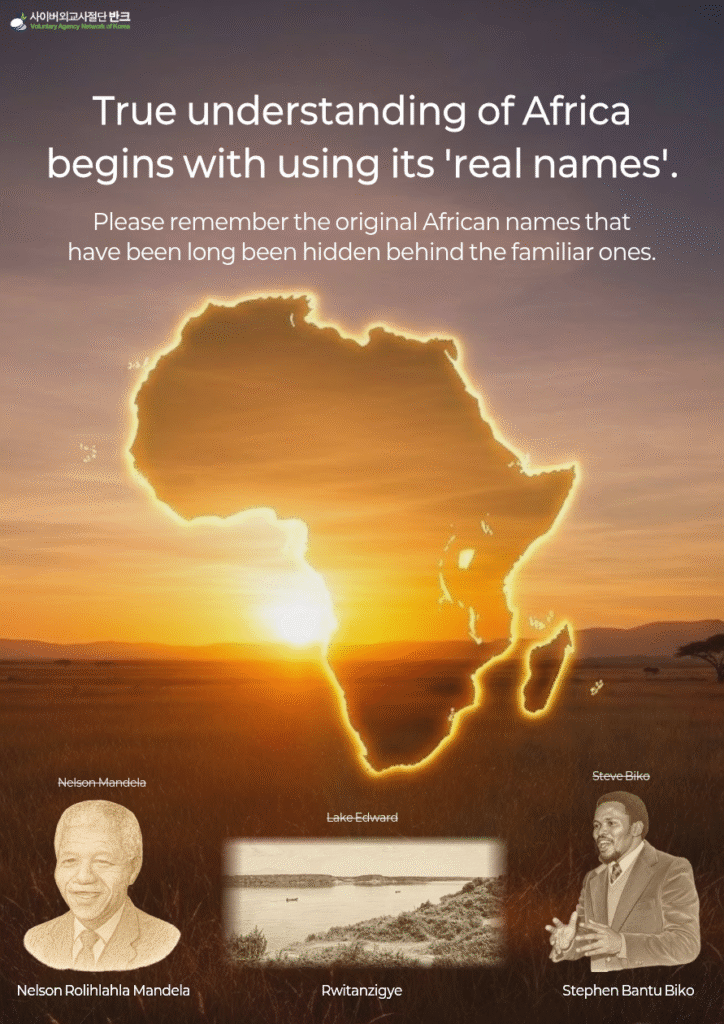
VANK has launched a campaign titled “Finding Africa’s Real Names,” aimed at remembering and restoring the original local names of African places and historical figures that have long been fixed in Western-centered forms. As part of the campaign, VANK plans to urge global knowledge platforms, including the Nelson Mandela Foundation, to adopt improved and more accurate name notations.
VANK has long worked to correct misinformation about Korea around the world. Recently, however, the organization has expanded its focus through an “Improving Awareness of Africa” campaign, seeking to challenge biased perceptions and structural distortions surrounding the African continent.
In June 2025, VANK also launched a campaign to promote the original name of Africa’s iconic natural heritage site, Victoria Falls. The falls’ indigenous name, Mosi-oa-Tunya, meaning “The Smoke That Thunders,” is listed alongside the colonial name on the UNESCO World Heritage register. Yet the site is still widely known only by the Western name derived from a British queen. VANK highlighted this contradiction while raising global awareness about the importance of restoring indigenous place names. Building on that effort, the organization has now expanded its activities into the broader “Real Name Restoration” campaign aimed at addressing the legacy of imperialism.
One of the most representative examples is former South African president Nelson Mandela, a global symbol of human rights and peace. His birth name in the Xhosa language was Rolihlahla Mandela, which means “one who pulls a tree branch” or “troublemaker.” In South Africa, many people honor him with the affectionate clan name Madiba, reflecting their deep respect and affection. However, on many global knowledge platforms and encyclopedias that people encounter first, he is still primarily identified by the Western name “Nelson,” given during the colonial era, which has effectively become the global standard. Even a leader who devoted his life to the struggle for Black human rights and peace is therefore remembered worldwide without his original name.
VANK points out that this Western-centered naming practice extends beyond individuals. A vast lake on the border of Uganda and the Democratic Republic of the Congo was long known to local communities as Rwitanzigye, a name expressing awe for nature and meaning “a place so vast that even swarms of locusts cannot cross it.” However, after British explorers traveling through Africa in the 19th century attached the name of a British queen’s son to the lake, it has continued to appear on global maps as Lake Edward.
VANK argues that this issue goes beyond simple naming conventions. During the colonial era, African languages were systematically excluded, while the languages of Western powers—such as English and French—were elevated to dominant status, creating what the group calls a “hierarchy of languages.” The remnants of imperialism embedded in language are not merely relics of the past. They continue to fuel political tensions and divisions across Africa today, as seen in the Cameroon Anglophone Crisis, where linguistic discrimination between English- and French-speaking regions—imposed during colonial rule—has escalated into violent conflict.
Despite this painful history, African countries have continuously sought to reclaim lost sovereignty and identity. A representative example is the capital of the Democratic Republic of the Congo. Once called Leopoldville, after a Belgian king notorious for brutally exploiting local people, the city reclaimed its indigenous name, Kinshasa, which had been used for centuries by local communities.
In line with these self-driven efforts in Africa, VANK plans to send an official letter to the Nelson Mandela Foundation. The organization will propose that the foundation lead efforts to officially include Mandela’s original name, Rolihlahla Mandela, alongside “Nelson Mandela” in its official channels and educational materials.
VANK also plans to urge major online platforms such as Google and Wikipedia to incorporate indigenous names into search algorithms and knowledge entries. The organization believes such changes are possible, pointing to a previous achievement. In 2019, after sustained advocacy, VANK succeeded in correcting the Japanese-style name “Kitei Son” for Korean marathon champion Sohn Kee-chung in Google’s Knowledge Graph, restoring his proper Korean name.
At the same time, the organization will run another campaign titled “African Languages in Our Daily Lives That We Didn’t Know About,” aimed at helping the public feel closer to Africa. By introducing African words that have already entered everyday global culture—such as “safari,” meaning “journey,” and the well-known board game Jenga, whose name means “to build” in Swahili—the campaign seeks to show that African language and culture are not distant or unfamiliar but deeply woven into the shared life of humanity, while encouraging warm respect for cultural diversity.
Kim Ryung-eun, a youth researcher at VANK who planned the campaign, said, “A name is not just a piece of text but an important cultural heritage that carries the history and identity of a community.” She added, “Showing gentle interest in placing Africa’s original names—long hidden behind familiar Western ones—alongside them on world maps and in dictionaries, and remembering them together, will be the first step toward creating a fairer global knowledge ecosystem.”
VANK Director Park Gi-tae also emphasized, “As confirmed through the Mosi-oa-Tunya campaign, we have reached a historic turning point where we must move beyond Western-centered perspectives in the way we write and remember the names of people and places.” He added, “For the people of the Republic of Korea, who have experienced the painful history of having our own names taken away, listening first to Africa’s real names and respecting them is the responsibility of mature global citizens seeking to build healthy international relations.”
Further details about VANK’s policy proposal can be found on its national policy suggestion platform, Woollim (https://www.woollimkorea.net/beginning-of-woollim/view.jsp?sno=3810).