
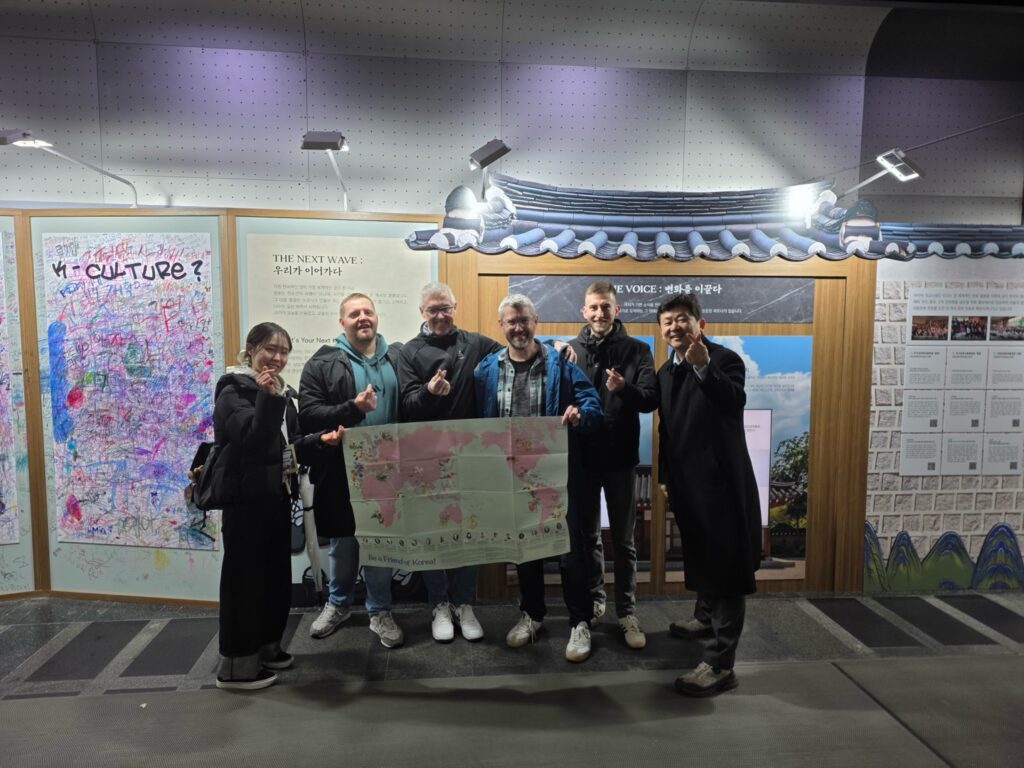
“Korea should not look down on developing countries just because it has achieved a certain level of economic success. Although the Korean Wave has become central to global culture, it is all the more important at times like this to respect and understand other cultures.”
Park Gi-tae, head of the Cyber Diplomacy Organization VANK (Voluntary Agency Network of Korea), made the remarks in an interview with Yonhap News Agency on March 2, 2026, at Nadeul-gil, the underground walkway of the National Museum of Korea in Yongsan-gu, Seoul, the venue of the “2026 Korea National Brand Up Exhibition.” He warned that government-led overseas assistance projects in the cultural sector could trigger backlash from partner countries.
Visiting the exhibition site on its final day, Park referred to the government’s recently announced “Fourth Comprehensive Basic Plan for International Development Cooperation (2026–2030)” and advised that it “must not become a one-sided effort to promote Korea.”
In the plan, the government said it would share its experience and know-how in the cultural and creative industries by building cultural industry infrastructure. It also specified that it would support the survey, preservation and research of cultural heritage using AI and ICT technologies, and pursue cooperation in branding cultural heritage and developing tourism resources.
Details are scheduled to be unveiled next month through a “Strategy for Official Development Assistance (ODA) in the Cultural Sector.”
Park suggested that “cultural ODA should be designed in a way that highlights the role of the private sector and citizens, rather than putting the government at the forefront.” While acknowledging that actively pushing projects to achieve results is positive, he added that safeguards should be put in place to prevent unnecessary misunderstandings.
He also stressed that “if young people take the lead in cultural ODA and voluntarily promote Korean culture to the world, it could create synergy,” adding, “We can confidently say that VANK’s various activities with 200,000 young members present a direction for cultural ODA.”
As an example, Park cited the Global Eulsa Heroes Campaign, which aims to honor heroes from various countries who resisted imperialism and, based on that shared history, build global solidarity for peace.
The campaign promotes Korean historical figures abroad while also introducing the heroes of those respective countries. It spreads awareness of the excellence of Hangeul across Asia while at the same time highlighting each country’s own language and culture.
“Season 1 of our activities focused on asking the world to pay proper attention to Korea,” Park said. “Now that Korea has become a well-known country, Season 2 will focus on how Korea can contribute to the world.”
The exhibition, jointly hosted by VANK and Yonhap News Agency under the theme “Hallyu Becomes Global Culture,” opened on February 25, 2026 and concluded successfully on March 2, 2026 after a six-day run.
Visitors heading to the National Museum of Korea via Ichon Station, where Subway Line 4 and the Gyeongui–Jungang Line intersect, stopped by the exhibition hall along the way to explore the roots and spirit of Korean culture.
Taking into account that about 60 percent of the museum’s daily visitors—around 17,000 people—use the Nadeul-gil walkway, VANK estimated that roughly 10,000 people per day, or about 60,000 over six days, visited the exhibition.
All 2,000 copies of a world map promoting Korea, given as gifts to those who listened to the full explanation by exhibition docents and posted about the event on social media platforms such as Facebook and Instagram or on the content-sharing platform Padlet, were quickly distributed.
A noticeable number of foreign tourists visiting Korea for vacation were also seen at the exhibition.
Three siblings of Ukrainian descent from Germany said, “In some ways, Korea’s entertainment industry surpasses Hollywood, the center of the U.S. film industry,” adding that “Korea is receiving global attention.”
A couple from France asked detailed questions about the background of magpies and tigers, a representative theme in Korean folk paintings, and were seen standing for some time discussing the competitiveness of Korean films and K-pop.
Cho Young-hwa, 26, an exhibition docent, said, “I took part with the mindset of studying because I wanted to help properly promote Korean culture,” adding, “Perhaps thanks to the popularity of the Netflix animation ‘K-Pop Demon Hunters,’ many children who came with their parents were also very interested in the Korean Wave.”
Some visitors also spoke highly of the joint efforts by VANK and Yonhap News Agency to enhance understanding of Africa and correct distorted information.
The exhibition introduced past achievements, including correcting misinformation in overseas textbooks and encyclopedias and addressing stereotypes about Africa in Korean elementary school textbooks.
Jang Han-byeol, 40, who visited the exhibition with her elementary school daughter, said, “Many children’s storybooks depict African children drinking dirty water and portray them with very dark skin,” adding, “I think balanced descriptions are needed even in private publications.”