
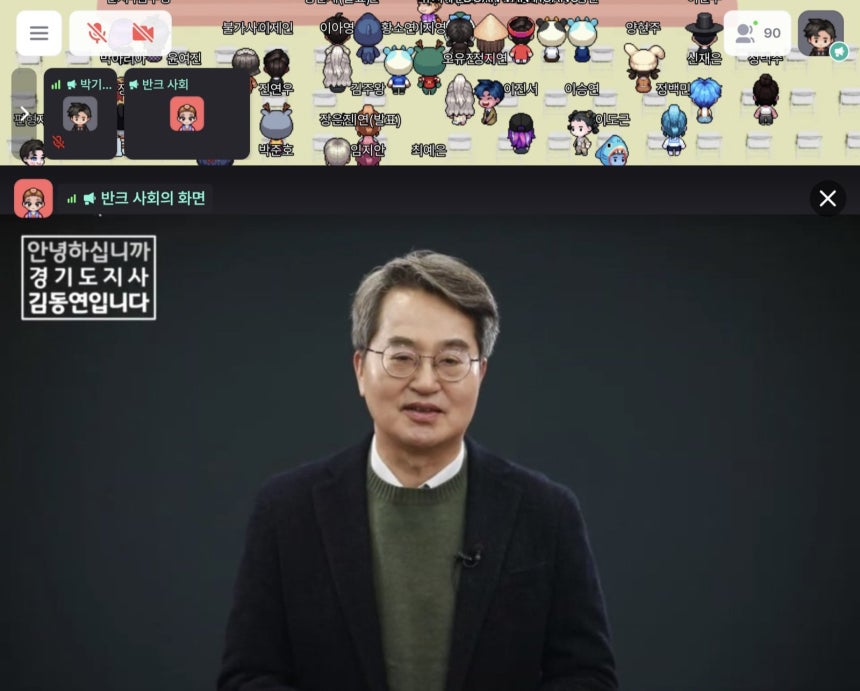
VANK, in cooperation with the Gyeonggi Provincial Government, held the launch ceremony for the first cohort of the “Global AI Ambassador” program on January 10, 2026, on a metaverse platform. The citizen-participation initiative was designed to address the growing problem of information errors in the age of artificial intelligence. The ceremony took place over the morning hours and marked the official start of activities for 219 youth and young adult participants selected as Global AI Ambassadors.
The event opened with a video address by Gyeonggi Governor Kim Dong-yeon. In his remarks, Kim referred to Gyeonggi Province’s long-standing partnership with VANK and reflected on how the role of citizen diplomacy is expanding amid changes in the digital environment. “VANK’s efforts to correct distorted information about Korea in textbooks, maps, and online content have been an important chapter in citizen diplomacy that properly introduced Korea to the world,” he said. “Now, that stage is expanding into a new space called AI.”
Kim added that in the AI era, the key issue is not the technology itself, but what information the technology uses to explain the world. “The Global AI Ambassador program represents a new form of diplomacy that builds trust in the AI age and plays a vital role in accurately presenting Korea,” he said. He also noted that Gyeonggi Province is building a trustworthy AI environment based on public data through its Artificial Intelligence Bureau, the first of its kind in Korea, and expressed hope that the program would develop into a citizen-participation AI governance model aligned with the province’s policy direction.
In a keynote lecture titled “Global AI Ambassadors: A Great Challenge,” VANK Director Park Gi-tae placed the role of Global AI Ambassadors in the context of Korea’s historical struggle against distorted information. He said that independence fighters, the Hague emissaries, and figures such as Homer Hulbert, who worked to convey Korea’s true history to the world, all fought to protect “information sovereignty.” “In the past, books, maps, and textbooks were the main arenas of distortion,” Park said. “Today, generative AI has taken their place.”
Park emphasized that Global AI Ambassadors go beyond simply identifying errors in AI-generated content. “They analyze these errors based on public data and connect their findings to civic action and policy proposals,” he said, describing the effort as an extension of citizen diplomacy into the AI space. He added that Korea in the 21st century must move from being a passive responder to distortion to an active leader in setting standards for information order and trust in the AI era, calling the ambassadors the starting point of that shift.
In a subsequent session, Kim Gi-byeong, head of Gyeonggi Province’s Artificial Intelligence Bureau, and Lee Eo-jin-bit, bureau chief, presented on the province’s AI achievements and future plans. They explained that Gyeonggi’s AI policies are expanding beyond internal administrative use of data to include direct citizen participation in verification. “The Global AI Ambassador program will serve as a real-world example of how public data can contribute to restoring social trust,” they said.
Kwon So-young, a researcher at VANK, analyzed cases of errors in generative AI and highlighted the potential impact of citizen engagement in the AI era. “AI has already become a new information environment that influences our perceptions and judgments,” she said. “What matters now is how citizens intervene in that flow.” She added that when citizens actively question and verify information, they can influence the direction of what AI systems learn, describing the program as a practical effort to build a more trustworthy AI ecosystem.
Kim Ye-rae, a VANK youth researcher, outlined the concrete role of Global AI Ambassadors through case-based presentations. She said AI errors are not simple mistakes but are repeatedly generated due to underlying data structures and perspectives. “The core activity of Global AI Ambassadors is to verify AI responses against public data and connect the results to reports and policy proposals,” she said. Sharing examples of distorted information found in Gyeonggi Province, Gyeongju, and North Chungcheong Province, she emphasized the significance of citizens directly identifying and correcting errors that recur nationwide. She added that Global AI Ambassadors are not merely critics of AI, but practitioners of citizen diplomacy who help accumulate reliable information and present Korea accurately in the global AI environment.
VANK youth researchers Baek Si-eun and Lee Sei-yeon also addressed the need for global sovereign AI. They warned that when generative AI relies too heavily on the data and perspectives of specific countries or companies, historical, cultural, and regional information can become distorted. The researchers stressed that each country must build and verify its own reliable data systems, noting that a combination of public data-based responses and citizen-led verification is essential for making sovereign AI work in practice.
Following the launch ceremony, Global AI Ambassadors will carry out online missions over approximately one month, divided into four stages. In the first stage, titled “From Indifference to Interest,” participants will post reviews of the launch event and lectures on blogs and social media to raise public awareness of trust and error issues in generative AI, while examining how AI describes Korea and Gyeonggi Province.
In the second stage, “From Interest to Action,” participants will identify errors, omissions, and distortions in AI-generated information related to Korea and Gyeonggi Province, analyze them using public data, and produce digital content such as card slides, posters, videos, and short-form video clips to share domestically and internationally.
The third stage, “From Action to Organization,” involves developing policy proposals to improve AI information accuracy through VANK’s policy platform “Woollim,” while using the “Yeollim” platform to evaluate existing policies and public data use and outline ways to expand citizen-led data verification systems.
In the final stage, titled “A Great Mission I Plan and Achieve,” participants will design and carry out global campaigns and challenges to promote trust in AI information and highlight the importance of public data.
Through these four stages, VANK expects Global AI Ambassadors to build critical skills to analyze information distortion in the generative AI era, while naturally internalizing the responsibilities of global citizenship by connecting data to policy and civic action.