
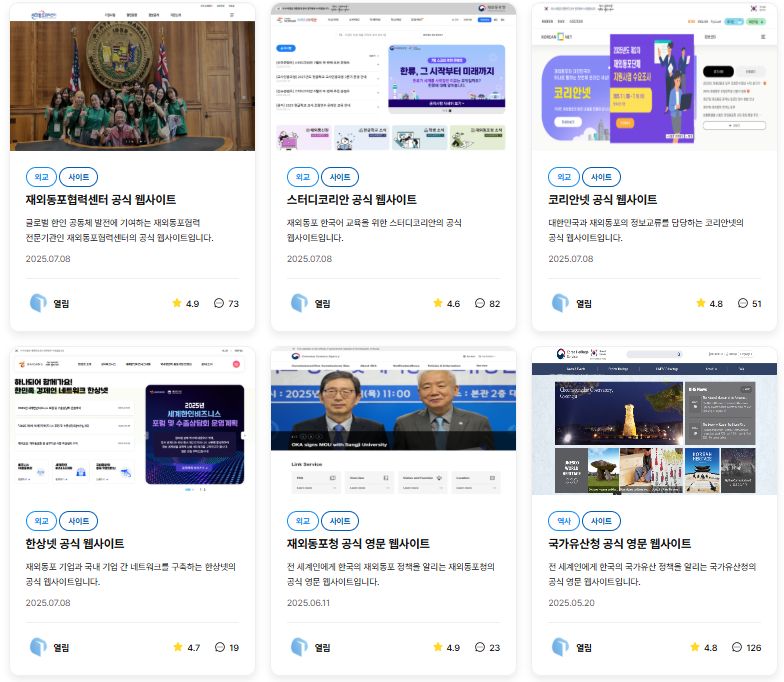
VANK has released an evaluation of online content produced by the Overseas Koreans Agency and its affiliated institutions, based on assessments conducted directly by teenagers and young adults through VANK’s government policy communication platform, Yeollim.
According to VANK, the evaluation covered major online platforms related to overseas Koreans, including HansangNet, the Overseas Koreans Cooperation Center, Study Korean, Korean.net, and the Overseas Koreans Education Portal. Since July 2025, VANK has run a participatory online review campaign through Yeollim, inviting teenagers, young adults, and members of overseas Korean communities to take part. The campaign examined official websites operated by more than 10 government ministries and affiliated agencies involved in overseas Korean policy, including the Ministry of Foreign Affairs, the Ministry of Culture, Sports and Tourism, and the Ministry of Education.
VANK noted that responsibilities related to overseas Koreans are spread across multiple ministries, making integrated management difficult. Even after the establishment of the Overseas Koreans Agency in 2023, the group said, a two-way communication structure that overseas Koreans can genuinely feel and use remains insufficient. In response, VANK launched the project to allow teenagers, young people, and overseas Koreans to directly evaluate online content and suggest concrete improvements, aiming to build a more active foundation for communication and cooperation.
VANK defines overseas Koreans as “co-designers” of Korea’s diplomatic, cultural, and education policies and as key partners in realizing the country’s global vision. About 7.5 million overseas Koreans living in more than 180 countries, the group said, are valuable partners who should help shape Korea’s future across politics, the economy, diplomacy, and culture. In reality, however, their voices are often not fully reflected in policy and institutional frameworks.
The organization pointed to history to underline this argument, noting that the dedication of overseas Koreans in the Americas played a crucial role in the establishment of the Provisional Government of the Republic of Korea in Shanghai and ultimately in Korea’s independence. That experience, VANK said, suggests that Korea in today’s global era can also be fully realized only through the active participation and cooperation of its overseas communities.
Against this backdrop, VANK argued that it is essential to assess how effectively government policies and online services for overseas Koreans—particularly those run by the Overseas Koreans Agency—are being delivered and whether they truly meet the expectations and needs of their users.
During the project, teenagers and young adults submitted more than 300 pieces of feedback and improvement ideas, directly contributing to discussions on overseas Korean policy and online service reform. A total of 23 comments were collected for the agency’s official English-language website, 19 for HansangNet, 51 for Korean.net, 82 for Study Korean, 73 for the Overseas Koreans Cooperation Center, and 89 for the Overseas Koreans Education Portal. VANK said these suggestions are especially meaningful because they are practical and detailed, grounded in the real experiences of users and learners.
In particular, evaluations of major education platforms under the Overseas Koreans Agency produced a wide range of perspectives from a student’s point of view. Participants analyzed learning materials, site structure, accessibility, and language services based on actual user experience, offering concrete directions for improvement rather than simple usage reviews. VANK described the findings as valuable data that show how online content is currently delivered to overseas Koreans and how it should evolve in the future.
Regarding the official English-language website of the Overseas Koreans Agency, Wang Seong-sin, who took part in VANK’s Korea Promotion Ambassador training, praised the clear and systematic organization of policy information, saying it was easy for overseas readers to understand. However, he suggested that moving beyond basic policy explanations and presenting the background and stories behind each policy in a storytelling format could further increase visitor engagement and understanding.
Lee Sei-yeon, a youth researcher at VANK, evaluated the Study Korean platform as a strong resource due to its extensive learning materials and personalized learning management system. She highlighted the ease with which learners can quickly find courses suited to their interests and proficiency levels, but pointed out that some content is not updated in a timely manner, limiting access to the most current materials. She emphasized the need for regular updates every two to three years and for learning content that reflects changes in Korean society and culture, describing this as essential for moving beyond static information toward living, up-to-date educational content.
Baek Si-eun, another VANK youth researcher, also offered a positive assessment of Study Korean for its menu structure tailored to different user groups, such as teachers, students, and schools. At the same time, she noted that the site currently operates only in Korean and English and called for the addition of major languages such as Chinese, Spanish, and Arabic. She also suggested providing a “quick start guide” or pop-up for course registration to help users unfamiliar with Korean adapt more easily, as well as simplifying complex menus to improve overall usability.
Turning to Korean.net, which serves as a key hub for information exchange between Korea and overseas Koreans, Lee Sei-yeon said the site provides useful information not only for overseas Koreans but also for people in Korea. She highlighted its broad coverage, linking news from local Korean communities to updates from government bodies and related agencies, including the Overseas Koreans Agency. The ability to view most content without membership registration and the site’s smooth coordination with related institutions were cited as strengths. However, she again stressed the need to expand language support, noting the lack of services in major overseas Korean languages such as Chinese and Japanese.
For the Overseas Koreans Education Portal, Kim Min-seong, who participated in VANK’s Korea Promotion Ambassador program, praised the wealth of professional resources for teachers and the distinctive college admissions counseling services for overseas students and parents, calling them key factors in user satisfaction. He also viewed the platform’s online joint education programs, which link remote learning opportunities, as a meaningful and timely response to current educational needs that offers real help to learners.
At the same time, he pointed out that the portal is heavily centered on teacher training and administrative materials, leaving limited customized information for students and parents. Community features, he added, are largely confined to notices and material sharing, making it difficult to encourage active participation. He suggested that more user-friendly information design, stronger customized content for diverse user groups, and expanded multilingual services could help the portal grow into a more globally accessible and practically useful education information platform.
VANK said the value of this evaluation lies in the fact that it captures vivid concerns and concrete solutions drawn directly from user experience. The project demonstrates that teenagers and young adults can critically analyze government policies while also proposing constructive alternatives, and it is being seen as a new model for government policy communication.
Park Gi-tae, head, of VANK, said the organization plans to continue a systematic project centered on Yeollim to comprehensively review and evaluate official websites, social media channels, and publications run by all government agencies in Korea. “Through this effort, we want citizens to move beyond being passive recipients of government policy and become active participants who help design and carry it out,” he said, adding that the ultimate goal is for the public to grow into true policy partners who think about and help realize Korea’s future vision.
Kwon So-young, a researcher at VANK, said the group plans to gradually expand the participation of Korean teachers and next-generation youth to strengthen governance within overseas Korean communities. By encouraging more active involvement in policy discussions and educational activities, she said, VANK aims to better reflect the voices of overseas Koreans. She added that the practical and detailed improvement proposals generated through youth participation can serve as important guidelines for helping government online platforms and policies evolve into more user-centered, customized services.
Koo Seung-hyun, another VANK researcher, emphasized that when the experiences and voices of real users—teenagers, young adults, and Korean teachers—are actively reflected in policy and service improvement, governments are better able to understand and respond to the real needs of overseas Korean communities. This, she said, lays the foundation for strengthening overseas Korean governance by creating structures in which communities can take part in policy decisions and education programs, ultimately leading to more effective and tangible communication systems that overseas Koreans can truly feel and use.