
As the APEC summit held in Gyeongju came to a successful close, VANK has raised concerns about distorted information about the city being spread through generative artificial intelligence (AI). With Gyeongju’s global profile significantly elevated by hosting a major international diplomatic event, VANK warned that inaccurate AI-generated content is shaping how people around the world perceive the historic city.
In response, VANK reviewed errors related to Gyeongju found in generative AI platforms and disclosed the seriousness of the problem. The investigation was carried out to assess the accuracy of AI-provided information on Korean history and culture and to prevent the overseas spread of false or misleading content.
VANK queried multiple generative AI platforms about Gyeongju and collected examples of errors. The review found that Google’s AI, Gemini, inaccurately depicted the internal structure of Seokguram Grotto, while Grok and Perplexity described Cheomseongdae as an ordinary astronomical observatory, offering images and explanations that differed from its actual form. In addition, several AI platforms failed to accurately reproduce the original design of the roof-end tile with human face motif, a symbol associated with APEC. Some AI systems even incorrectly identified Seoul, rather than Gyeongju, as the host city of the APEC summit. VANK compiled these cases into a report on AI-related errors and released the findings at a press conference at the National Assembly.
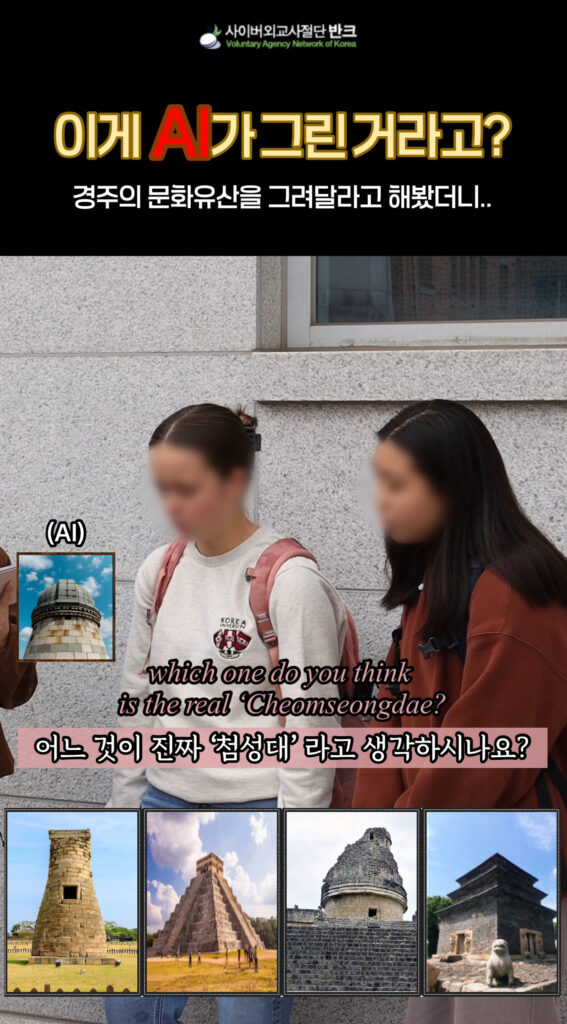
Alongside the AI review, VANK conducted street interviews in which foreign participants compared AI-generated images of cultural heritage sites with real photographs, allowing them to directly observe the differences and distortions. The interviews were designed to strengthen the credibility of the findings by examining both foreign awareness levels and the influence of AI-generated information.
Most of the AI images reviewed showed noticeable differences from reality in terms of structure and texture, and some even borrowed cultural elements from other countries. One interview participant said that without access to original reference materials, it would be difficult to judge accuracy based solely on AI images, adding that they would likely have accepted the distorted information as fact. The interviews confirmed that when AI-generated content is combined with users’ limited background knowledge, there is a high risk that Gyeongju’s historical and cultural identity will be misrepresented.
Further discussions during the interviews focused on AI errors related to the APEC host city. Participants pointed out that such mistakes stem from AI systems mechanically combining information gathered online without a true understanding of the subject. They warned that unless users verify the information themselves, confusion is likely to follow. The participants stressed the need for cooperation between governments and AI companies to correct errors, while also urging citizens to actively distinguish and verify accurate information.
Kim Ye-rae, a youth researcher at VANK who planned the project, said some AI platforms incorrectly listed Seoul as the APEC host city and provided inaccurate details about performance schedules, venues, and tourist sites. “Information about internationally significant events like APEC is often unfamiliar to foreign audiences,” she said. “When such errors occur, they can damage Gyeongju’s credibility and image, and distort how the city is presented as the face of Korea at a major global summit.” She called on generative AI companies to immediately correct these mistakes and work closely with Korean public data sources to ensure accuracy.
Based on the findings, VANK urged generative AI companies to promptly fix errors and collaborate with Korea’s public data systems to provide reliable information. The group also emphasized the importance of active public participation, saying that only when citizens themselves identify and correct AI errors can the true value of cultural heritage be protected.
Park Gi-tae, head of VANK. said that as generative AI platforms, alongside traditional media, have become key gateways for global information, misinformation delivered to foreign audiences can go beyond simple mistakes and directly affect Korea’s historical and cultural image. “It is urgent to build a system in which the government, the private sector, and citizens work together to systematically verify and correct AI errors,” he said.
The case highlights that as generative AI becomes a primary source of information worldwide, governments, companies, and citizens alike must take on responsible roles. To prevent the spread of distorted information caused by AI errors, the report underscores the urgent need to build a “responsible AI ecosystem” that combines accurate public data with active citizen participation.