
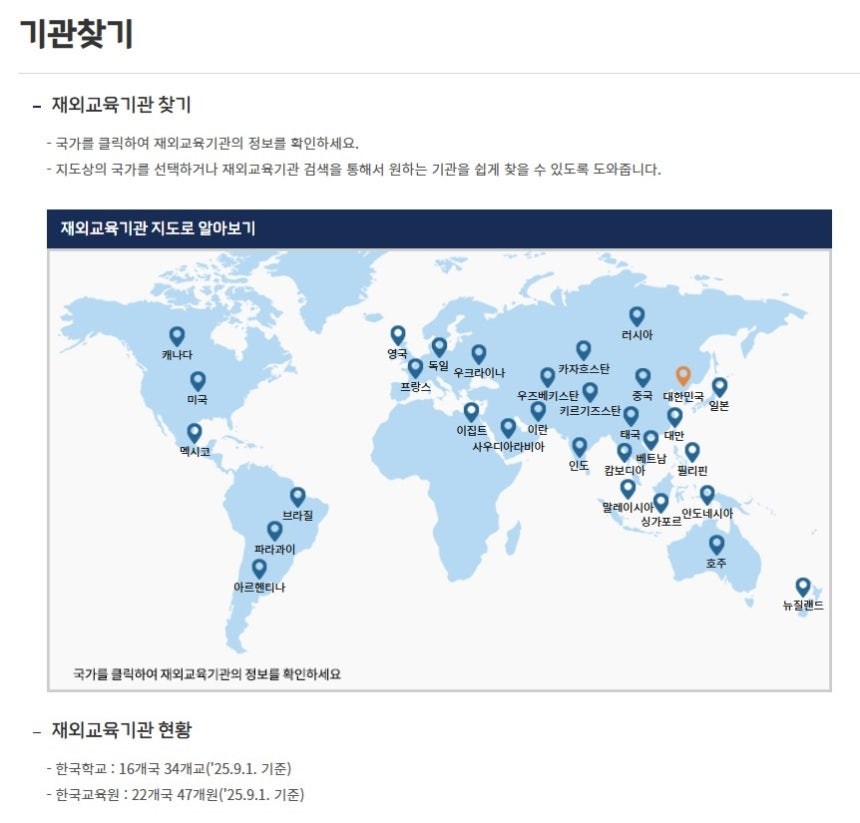
VANK said on November 11, 2025, that it is continuing its campaign urging the Ministry of Education of Korea to adopt “accurate world maps” that reflect the true size and shape of the African continent.
In a recent post on the national policy proposal platform Woollim (www.woollimkorea.net), VANK pointed out that official materials produced by some institutions under the Ministry of Education still rely on maps with severe area distortion. The group called for correcting the widespread use of the Mercator projection, which it said misrepresents the world.
Originally developed in 16th-century Europe for maritime navigation, the Mercator projection greatly enlarges high-latitude regions such as Europe and North America, while showing Africa as far smaller than its actual size.
According to VANK’s findings, distorted representations of Africa were found in materials produced by several education-related bodies under the ministry. These include the Overseas Koreans Education Portal, academic resources from the Korea Education and Research Information Service, promotional booklets and overseas support materials from the Academy of Korean Studies’ Korean Studies Promotion Service, and learning resources on the EDUNET platform.
VANK said that even when searching for “world map” on the Ministry of Education’s blog or EDUNET, materials from more than a decade ago still appear prominently. “As the international community has moved toward projections such as the Robinson or Equal Earth maps, which better reflect real area proportions, the Ministry of Education should also actively adopt updated maps,” the group said.
The Equal Earth projection, recommended by the African Union (AU), is widely regarded as one of the most accurate world maps for representing the true size of countries and continents.
VANK said it produced the first Korean-language version of the Equal Earth map on November 10, 2025, and plans to distribute it through its official website to schools and public institutions both in Korea and overseas.
Lee Sei-yeon, a youth researcher at VANK, said educational map materials used by the ministry influence not only students in Korea but also overseas Koreans studying about Korea abroad. “If accurate world maps that meet international standards are introduced, it will allow students at home and abroad to view the world without distortion and make genuine global citizenship education possible,” she said.
Park Gi-tae, head of VANK, also stressed that Africa is not a distant or unfamiliar continent, but a neighbor that shares historical experiences similar to Korea’s, including colonial rule. “The essence of global citizenship education lies in building the ability to understand and empathize with one another as we truly are, and accurate world maps are a starting point for that,” he said.