
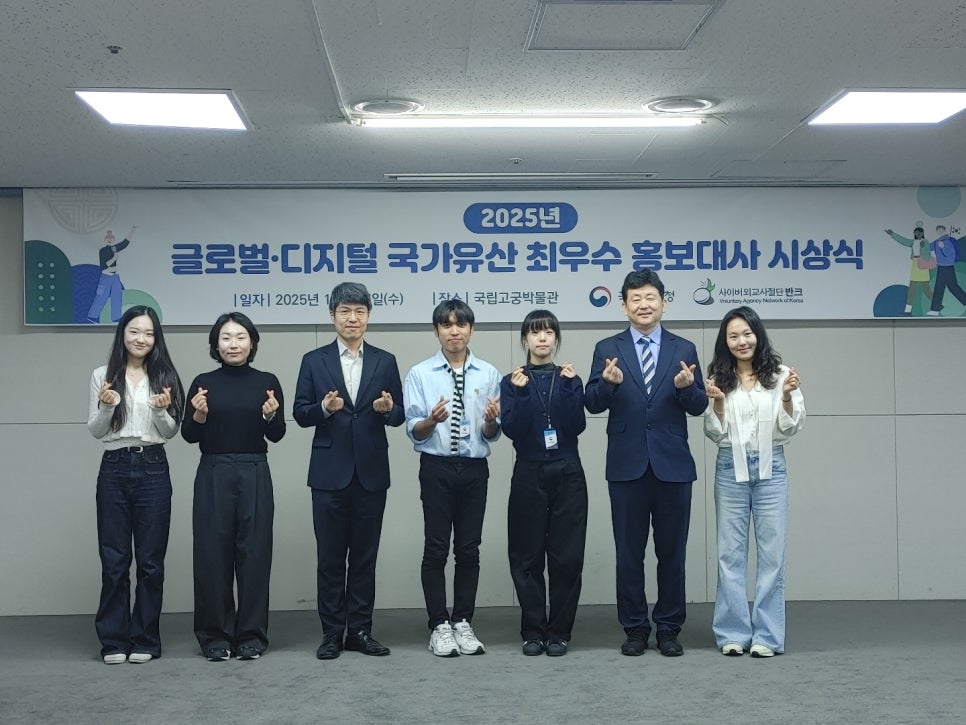
VANK and the Korea Heritage Service held the “2025 Global and Digital Cultural Heritage Best Ambassador Awards Ceremony” on December 17, 2025, at the main auditorium of the National Palace Museum of Korea.
The event was attended by VANK Director Park Gi-tae, officials from the Korea Heritage Service’s Overseas Heritage Cooperation Division, Global and Digital Cultural Heritage Ambassadors, and VANK researchers Lee Sun-hee, Kwon So-young, and Koo Seung-hyun. VANK and the Korea Heritage Service selected top ambassadors from among participants in the Global Cultural Heritage Ambassador and Digital Cultural Heritage Ambassador programs for youth and young adults, with winners receiving awards presented in the name of the head of the Korea Heritage Service.
The ceremony was hosted by VANK researcher Kwon So-young and featured presentations on the awardees’ activities and reflections, followed by the presentation of the commissioner’s awards.
This year’s top ambassadors were Wang Xingchen, a Chinese national from the 8th cohort of Digital Cultural Heritage Ambassadors, and M. Mahbubdin Ridha Alfasya, an Indonesian national from the 4th cohort of Global Cultural Heritage Ambassadors.
In his presentation, Wang said that during the second mission stage, titled “Turning Interest Into Action,” he carried out a campaign focused on jeon, a traditional Korean ceremonial food. He explained that he realized using the original name jeon rather than translating it as “Korean pancake” helps preserve the uniqueness of the culture. He added that many Chinese traditional foods also lose their original meaning and appeal when forcibly translated into English, noting that preserving original names is a first step toward respecting cultural diversity.
Wang also described his work during the fourth mission stage, “Turning Organization Into Change,” in which he investigated whether nongak, a traditional Korean performing art, was listed in English dictionaries. After confirming that it was not included in the Oxford English Dictionary, he submitted a request for its inclusion.
He further pointed out errors generated by AI systems. Wang shared an example in which a request to ChatGPT to show the scenery of Hoeryongpo in Yecheon resulted in an image that failed to reflect the site’s distinctive river curves and natural landscape, instead producing a generic riverside village image. He said such errors could mislead foreigners learning about Korean culture and noted that he submitted a correction request to ChatGPT, receiving a positive response stating that his feedback would be passed on to the technical team. Through this experience, he said, he learned that actively correcting misinformation is the starting point for accurately promoting cultural heritage.
Reflecting on his experience, Wang said that while he had previously been in the position of learning about Korean culture, the program allowed him to take on the role of a messenger who explains and shares what he learned with foreign friends. He added that the experience reinforced his belief that “culture shines brighter when it is shared.”
M. Mahbubdin Ridha Alfasya introduced a range of activities he took part in, including the ambassador launch ceremony, visits to royal palaces, a field trip to Namwon, and cultural content he personally produced. He said that completing the ambassador missions helped him better understand the importance of hands-on cultural experiences from a foreigner’s perspective, allowing him to gain deeper insight into Korean cultural heritage and create more authentic content.
He also conducted interviews with fellow international students to identify Korean travel destinations they frequently visit. During this process, he introduced the Korea Heritage Service’s official English-language website, sharing that it provides systematic guidance on historical and cultural sites from the perspective of foreign visitors.
In addition, he carried out activities comparing cultural heritage in Korea and Indonesia. Using Indonesia’s traditional music gamelan as an example, he highlighted shared artistic values and a sense of harmony found in the cultural heritage of both countries.
VANK Director Park Gi-tae said the ceremony was especially meaningful because all of this year’s awardees were international students. He noted that despite not being from Korea, they actively worked to accurately introduce Korean culture to the world, adding that their efforts show how Korean cultural heritage can become a new kind of Hallyu star that connects people globally.
Park also stressed the need to move beyond one-way cultural promotion toward two-way cultural exchange that introduces the histories and cultures of countries such as China and Indonesia alongside Korea’s. He added that many international conflicts stem from a lack of mutual understanding and called for more mature cultural exchange that respects other cultures as much as one’s own.
Lee Sun-hee, senior researcher at VANK, said the Global and Digital Cultural Heritage Ambassador program is not simply about cultural promotion but about interpreting and conveying Korean heritage in the language of global citizens. She described this year’s top ambassadors as proactive individuals who recognized problems and proposed solutions in an era when cultural heritage can be distorted or reduced to simple consumption through AI.
Seo Jeong-sam, an official at the Korea Heritage Service’s Overseas Heritage Cooperation Division, thanked the awardees for their passion in promoting Korean cultural heritage accurately around the world. He encouraged them to also cherish and protect the heritage of their own countries, adding that cultural heritage is passed down through the dedication and efforts of countless people and should be viewed with a mature, global perspective.
Since signing an MOU with the Korea Heritage Service in 2021, VANK has worked to promote Korean cultural heritage worldwide through initiatives such as training digital cultural heritage ambassadors and cooperating on efforts to list heritage sites.
VANK said it plans to go beyond training Korean youth as cultural ambassadors and will continue expanding programs to nurture global ambassadors among the 7.5 million overseas Koreans and some 200 million Hallyu fans around the world.