
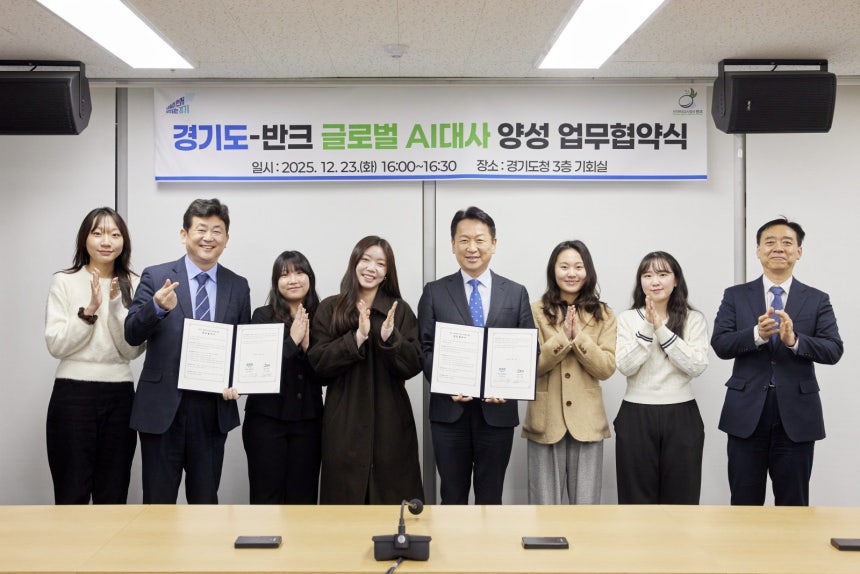
VANK and Gyeonggi Province signed a memorandum of understanding (MOU) on Dec. 23, 2025, to jointly train “Global AI Ambassadors.”
The agreement follows discussions held in October between Gyeonggi Governor Kim Dong-yeon and VANK Director Park Gi-tae. At the time, the two sides hosted a “Gyeonggi Generative AI Roundtable,” where they reviewed errors related to Gyeonggi Province found in generative AI systems and shared the need for cooperation to foster Global AI Ambassadors as part of efforts to build “sovereign AI” based on accurate regional information.
During the roundtable, VANK presented examples of AI-generated errors, including cases in which Nami Island—currently located in Chuncheon, Gangwon Province—was incorrectly identified as being in Gapyeong, Gyeonggi Province, and instances where the relocation year of the Gwanggyo Provincial Government Complex was variously listed as 2016 or 2023. Errors were also found in descriptions of Gyeonggi policies such as climate action and climate income programs, the bus transfer system, and youth policies, as well as cases where images of cultural heritage were altered or historical context was reduced, highlighting the need for corrections.
Governor Kim suggested exploring ways to encourage public participation, saying incentives could be offered not only to government offices but also to ordinary residents who identify AI errors, and called for the establishment of a public-private cooperation system.
In response, Gyeonggi Province worked with VANK to plan the Global AI Ambassador program as part of efforts to build a participatory governance model that addresses the spread of unverified information and errors produced by generative AI.
The agreement is significant in that VANK and Gyeonggi Province will, for the first time, systematically train Global AI Ambassadors among teenagers and young adults, particularly Gyeonggi residents. The goal is to correct misinformation spreading in the AI era and establish a sustainable system for sharing accurate information with the world. Both sides expect the partnership to serve as a model for public AI cooperation globally.
Following the signing ceremony, VANK youth researchers Kim Ye-rae, Lee Sei-yeon, and Baek Si-eun presented plans for future activities.
Kim Ye-rae outlined the operational plan for the Global AI Ambassador project, saying the program aims to train young people to identify and analyze information errors in generative AI and build a citizen-based monitoring workforce. She added that results would be shared transparently with residents through exhibitions and expanded education programs related to Gyeonggi’s AI policies.
She also explained plans to develop AI performance evaluation indicators and a campaign platform to collect error cases as data and turn them into assets for future policy improvements and public outreach. Official appointment certificates issued in the governor’s name and volunteer hour recognition will be provided to ensure accountability, while project outcomes will be organized into usable administrative data so that youth participation can feed directly into policy discussions. The ultimate goal, she said, is to establish a system in which Gyeonggi Province continuously manages AI-generated information about the region together with young people.
Lee Sei-yeon presented plans for online and offline exhibitions to showcase the achievements of AI ambassadors. She said the exhibitions will be centered around the Gyeonggi Library and linked to public library displays featuring outstanding content created by participants, allowing residents to naturally engage with the work and spread the idea that “anyone can become an AI ambassador.”
She noted that at a time when AI policy is still seen as an expert-driven field, officially exhibiting outcomes created through citizen participation will help show how Gyeonggi’s AI policies are actually used, in language that residents can relate to, and will contribute to greater understanding and public awareness.
Lee also introduced plans for AI education programs centered on affiliated provincial institutions, libraries, and universities. She said that by building programs around these three pillars and managing outcomes under a unified AI error-correction format, data on AI-related errors concerning Gyeonggi Province can be systematically accumulated. She stressed the importance of leveraging the expertise of affiliated institutions, hands-on education and exhibitions through libraries, and campus-based AI education and generative AI hackathons in cooperation with universities.
Baek Si-eun presented plans to develop generative AI performance evaluation indicators and build a campaign website. She explained that the indicators would serve as standards for identifying AI models that provide accurate Gyeonggi-related information and can be trusted by residents, noting that current AI evaluations are largely focused on companies or technology, with no clear public-sector standards at the local government level.
She added that establishing evaluation indicators at the local government level would improve AI reliability in a transparent way, provide residents with criteria for choosing trustworthy AI models, and create a standard that could be expanded to other regions. She also stressed the need for VANK and Gyeonggi Province to jointly build a dedicated website for Global AI Ambassadors to introduce activities, archive results, and share participation programs, turning the initiative into a sustainable public AI campaign rather than a one-time project.
Under the agreement, Gyeonggi Province and VANK plan to cooperate on responding to generative AI errors in public information, planning and supporting Global AI Ambassador programs, raising awareness of AI errors and promoting responsible use, and strengthening public-private cooperation at home and abroad.
Gyeonggi Province said it aims to strengthen public trust in the AI era through citizen participation and establish a responsible system for producing and using information. VANK plans to openly recruit Global AI Ambassadors, who will take part in detecting and proposing corrections for AI errors, AI literacy education, and producing online campaign content.
Park Gi-tae, head of VANK, said that while VANK has often been seen as focused on culture, diplomacy, and history, accurately presenting Korea and Gyeonggi Province to the world is directly linked to economic competitiveness. He warned that in an era where brand image shapes national and regional trust, distorted information spread through AI can quickly undermine credibility.
He added that Global AI Ambassadors represent a world-first concept and that, together with Gyeonggi Province, VANK will become the first local government partnership to train AI ambassadors in the diplomatic field. By improving the accuracy of Gyeonggi-related information reflected in AI—especially as global fans of Korean culture increasingly use AI to search for travel information—the initiative aims to strengthen global trust in the province.
Gyeonggi Vice Governor for Economic Affairs Ko Young-in said that in the AI era, the accuracy of public information is directly tied to trust in government. He expressed hope that the Global AI Ambassador program will help young people recognize the challenges of generative AI and grow into responsible users, adding that the province will create an environment for responsible AI use through public-private cooperation based on social responsibility and public trust.
He emphasized that as AI has become a core part of social systems and infrastructure across industry, work, and daily life, its responsible use based on accurate information is more important than ever. He also stressed that “sovereign AI” should be based on national information while remaining open to international cooperation and global balance, adding that Gyeonggi Province will actively respond to distorted information through cooperation with VANK and work with residents to build a trust-based public AI environment.