
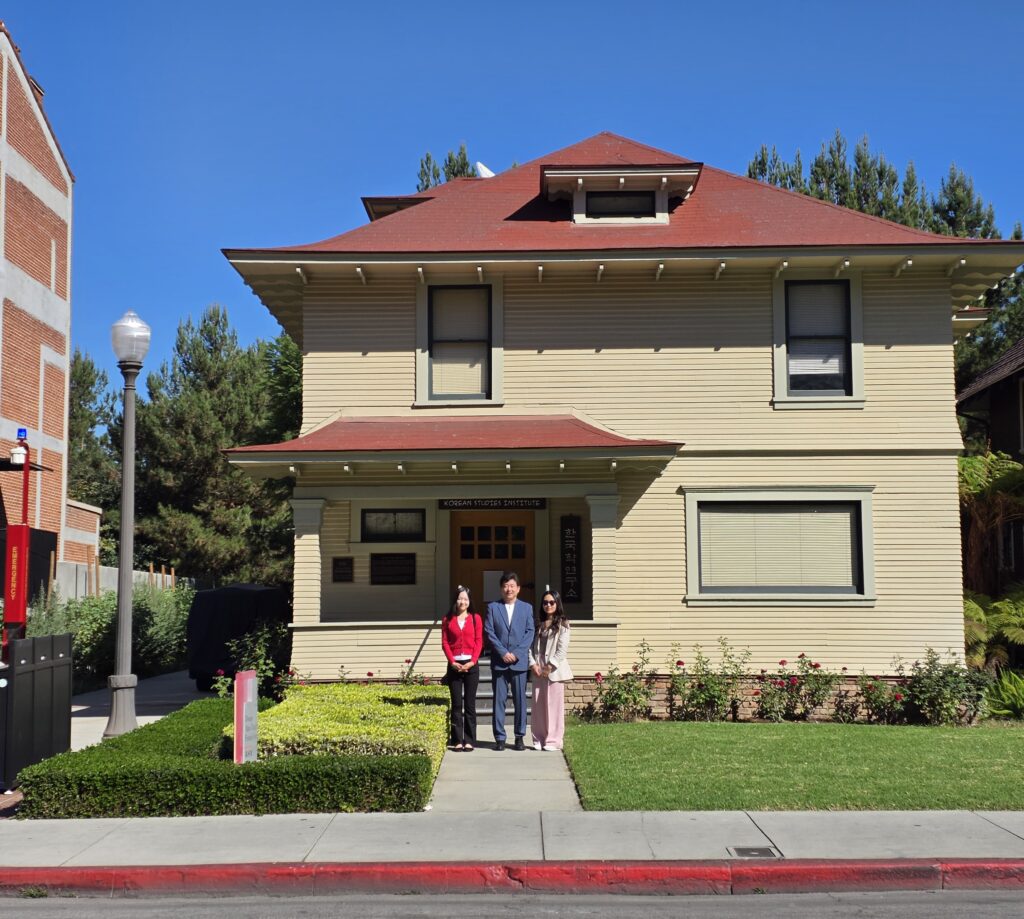
On October 30, 2025 (local time), The Voluntary Agency Network of Korea (VANK) held a special lecture titled “We Are the Hallyu Ambassadors!” at the former residence of Korean independence leader Dosan Ahn Chang Ho, located on the University of Southern California (USC) campus. The event aimed to promote a deeper understanding of Korean history and culture among international students and to inspire them to become global advocates of the Korean Wave, or Hallyu.
Dosan’s former home, where he and his family lived from 1937 to 1946, served as a vital gathering place for the Korean-American community during the independence movement. Today, the residence houses the USC Korean Studies Institute, which holds one of the largest collections of Korea-related books in the United States and serves as a hub for Korean studies.
During the lecture, VANK Director Ki-Tae Park reflected on the life and ideals of Dosan Ahn Chang Ho, a pioneer of Korea’s independence movement. Park emphasized the special significance of holding the event at the home of Ahn, who at the age of 24 traveled to the United States to broaden his worldview. Witnessing discrimination against Koreans and widespread misconceptions about Korea, Ahn sought change through action — organizing community cleanups, improving living conditions, and inspiring his compatriots through his leadership. He later established an orange farm to provide jobs for Korean immigrants, working alongside them with the conviction that “even picking an orange should be done with a patriotic heart.” His efforts not only uplifted the Korean community in America but also contributed to the eventual unification of the Korean Provisional Government.
Park noted that VANK continues to carry forward Dosan’s spirit through what he called a “21st-century independence movement” — correcting global misconceptions about Korea in international education and media. He pointed out instances in U.S. world history textbooks where Korean history has been inaccurately portrayed as part of Chinese or Japanese history, stressing that rectifying such distortions is part of fulfilling Ahn’s dream of national dignity and global understanding.
Researcher Seung-Hyun Koo of VANK presented practical ways for students to identify and correct inaccuracies about Korea found in major U.S. museums, art galleries, and encyclopedias. Koo also explained how VANK successfully persuaded several major American institutions to revise displays that had labeled the sea between Korea and Japan solely as the “Sea of Japan,” replacing them with more balanced terminology.
Researcher So-Young Kwon then addressed the issue of misinformation about Korea being spread through generative artificial intelligence (AI). She highlighted examples of AI models perpetuating outdated or inaccurate descriptions of Korean history and culture, urging students to use verified resources provided by VANK to ensure accurate representation of Korea in AI-generated content.
Professor Kim Bo-Hyun, who attended the event, noted that videos produced by VANK have already been used in USC Korean language classes. “I hope this special lecture encourages our students to go beyond learning the Korean language and develop a deeper interest in Korean culture and history,” Kim said.
In commemoration of the 80th anniversary of Korea’s liberation, VANK is also visiting Korean-American communities in San Francisco and Los Angeles at the invitation of the Korean American Federation of San Francisco Bay Area. Through these initiatives, VANK aims to inspire Korean expatriates to become “independence activists of the 21st century.”
Looking ahead, VANK plans to connect 7.5 million overseas Koreans and 200 million global Hallyu fans, continuing the legacy of Korea’s independence heroes by building a nation that serves as a dynamic cultural bridge — the gateway to Northeast Asia and a global partner in friendship and dreams.