
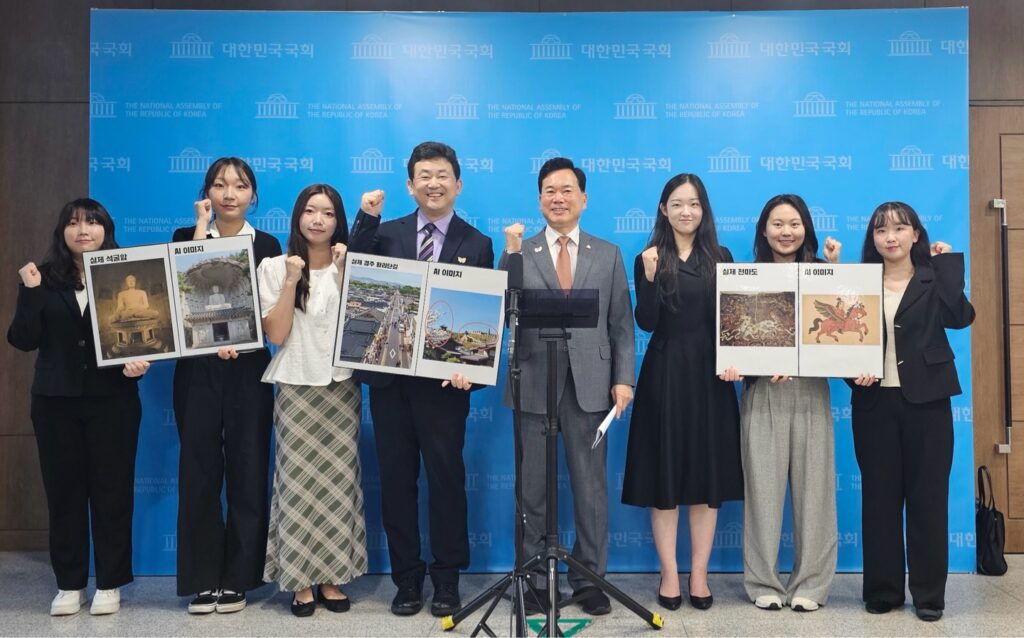
The Voluntary Agency Network of Korea (VANK) and Representative Kim Seung-soo of the National Assembly’s Culture, Sports and Tourism Committee (People Power Party, Buk-gu, Daegu) held a joint press conference at the National Assembly on October 16, 2025, calling for urgent government action against growing distortions of Korean history and culture in generative AI platforms. The appeal was directed to the 2025 APEC Korea Organizing Committee, the Ministry of Culture, Sports and Tourism, and the Ministry of Foreign Affairs.
VANK Director Park Ki-tae attended the briefing alongside researchers Kwon So-young and Gu Seung-hyun, and youth researchers Lee Jung-woo, Kim Ye-rae, Baek Si-eun, and Lee Se-yeon.
“Today, people no longer rely solely on portal sites for information—generative AI is fast becoming a primary search tool,” said Rep. Kim. “Yet the results produced by these AI models still contain numerous inaccuracies and distortions, especially concerning Korea’s history and culture.” He warned that since many foreign users tend to accept AI-generated information as fact, “these errors could easily spread distorted images of our history and culture worldwide.”
Rep. Kim and VANK jointly investigated several instances of misinformation, particularly regarding Gyeongju—the host city of the 2025 APEC Summit scheduled in two weeks. According to their findings, Google’s AI model Gemini depicted the Seokguram Grotto without its actual interior chamber, while Grok and Perplexity described Cheomseongdae, one of Asia’s oldest observatories, as a modern astronomical facility.
In addition, the symbolic roof-end tile with a human face, representing APEC 2025, was misrepresented across multiple AI platforms including Gemini, Copilot, and Grok, none of which accurately reproduced its original design. Some even incorrectly stated that the APEC venue was Seoul instead of Gyeongju.
“If such errors were to circulate globally during the APEC Summit, it could cause serious confusion about our national image and local identity,” Kim warned. He urged the government to establish a systematic process to supply AI developers with accurate heritage data, recommending that agencies such as the National Heritage Administration take the lead in building structured public datasets for AI learning.
VANK youth researcher Kim Ye-rae, who participated directly in the AI distortion analysis, explained, “When we asked generative AI about Gyeongju’s administrative and cultural information, some models misidentified Seoul as the host city of APEC, provided incorrect schedules and venues for performances, and described tourist sites inaccurately.” She added, “Such misinformation undermines Gyeongju’s credibility. As the city preparing to welcome the world for APEC, AI companies must correct these errors immediately and collaborate closely with Korean public data sources to ensure accurate information.”
Another youth researcher, Baek Si-eun, found similar problems when analyzing data related to Gyeongju’s intangible heritage and historical figures. “Many AI systems lacked sufficient data, leading them to misclassify Gyeongju’s heritage status or distort historical facts,” she said. “It is time for all government ministries—including the APEC Korea Organizing Committee, the Ministry of Culture, and the Ministry of Foreign Affairs—to go beyond mere event promotion and actively safeguard our history, sovereignty, and identity from AI-driven distortions.”
Youth Researcher Lee Se-yeon emphasized the need for civic participation. “To ensure Gyeongju’s culture is represented accurately in AI, engagement from Gyeongsangbuk-do residents and Gyeongju citizens is essential,” she said. “When citizens understand their region, detect AI errors, and help correct them, only then can the true value of our cultural heritage be preserved.” She added, “The APEC Summit is a major diplomatic stage to showcase Korea’s cultural identity to the world. Correcting AI distortions is not just the responsibility of the government or experts—it is a shared national task. Collective participation will lay the foundation for a ‘sovereign AI era’ free from dependence on foreign technologies.”
VANK Director Park Ki-tae noted that if major media outlets like CNN or The New York Times had misreported Gyeongju as Seoul, “every government agency would have responded immediately.” He warned, however, that “while global information dissemination has expanded beyond traditional media into the AI sphere, Korea’s response remains insufficient.”
“Information gateways for people around the world now include not only the press but also generative AI platforms,” Park said. “AI’s training data and algorithms increasingly shape how a nation’s culture and history are perceived.” He added that VANK, which has spent the past two decades correcting errors such as the labeling of Dokdo as Takeshima and the East Sea as the Sea of Japan in foreign textbooks and websites, must now extend these digital diplomacy efforts into the age of artificial intelligence.
Researcher Kwon So-young highlighted the importance of combining technology with cultural integrity. “The government’s ‘Sovereign AI’ initiative aims to build an independent AI ecosystem using Korea’s own data, infrastructure, and talent,” she said. “But technological advancement alone is not enough. We must also preserve and promote our unique history, culture, and identity alongside it.”
“Through our national policy communication platform, VANK is working to ensure that Korea’s historical and cultural information is accurately conveyed in the age of generative AI and to develop strategies to detect and correct misinformation,” Kwon added.
Researcher Koo Seung-hyun pointed out that while nations worldwide are racing to become AI leaders, most focus solely on technical competitiveness. “Korea must go beyond that,” she said. “We must build AI that not only excels technologically but also respects and reflects our historical and cultural identity.”
Youth researcher Lee Jeong-woo concluded, “To build a responsible AI ecosystem that faithfully represents Korea’s history and culture, cooperation among government, the private sector, and citizens is essential. A systematic national framework for data provision and response is needed to prevent foreign AI platforms from reproducing distorted information about our country.”