
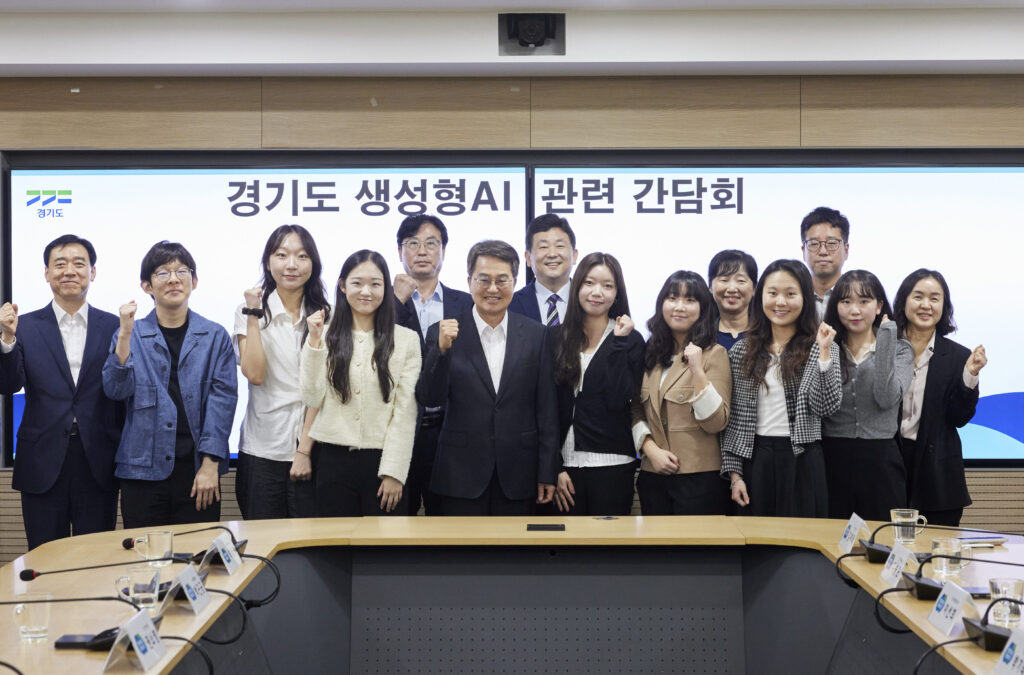
The Voluntary Agency Network of Korea (VANK), led by Director Park Ki-tae, and the Gyeonggi Provincial Office, headed by Governor Kim Dong-yeon, jointly hosted the Gyeonggi-do Generative AI Forum on October 13, 2025, at Seohee Hall in the Gyeonggi Provincial Office building.
The forum carried special significance as generative AI tools continue to spread rapidly across the globe. It aimed to identify and correct inaccuracies and distortions related to Gyeonggi Province found in global AI platforms, while laying the groundwork for the realization of “AI sovereignty” based on verified, locally grounded information.
VANK signed a memorandum of understanding (MOU) with Gyeonggi Province in 2024 and has since been co-running the Global Climate Ambassador program for youth and young adults. As part of this collaboration, VANK published the Gyeonggi-do AI Policy Report, which analyzed misinformation about the province within generative AI platforms and proposed policy recommendations for improvement. During the forum, VANK’s youth researchers presented the report’s key findings, highlighting major errors and strategies for correction.
Kim Ye-rae, a youth researcher, opened with a presentation on administrative and policy-related inaccuracies, revealing multiple errors in how AI platforms describe Gyeonggi’s governance and public services. One notable example was the misidentification of current Governor Kim Dong-yeon, who took office in July 2022—AI systems instead listed former governor and current President Lee Jae-myung as Gyeonggi’s governor as of 2025.
Kim also pointed out misleading information regarding Gyeonggi’s climate income initiative, local bus transfer system, and youth basic income policy, noting that such inaccuracies could cause real-life confusion for residents. “As more people now obtain information through generative AI rather than traditional search engines, inaccuracies in administrative, policy, and tourism information about Gyeonggi Province can cause confusion and inconvenience for residents,” she warned.
Lee Se-yeon, another youth researcher, presented findings on inaccuracies in AI-generated content about Gyeonggi’s tangible cultural heritage. Lee categorized the errors into two main types: image reproduction errors and historical omission or distortion.
Representative examples included the Godaesa Temple Stone Pagoda in Yeoju, Rock-carved Bodhisattva Statue in Jangam-ri, Icheon, Rock-carved Seated Medicine Buddha in Gyosandong, Hanam, and Rock-carved Standing Buddha in Yongmi-ri, Paju. Lee noted that generative AI often produced unrelated images for these sites, thereby distorting their essence. The AI models, she explained, fail to capture each heritage site’s unique characteristics, resulting in an oversimplified and homogenized portrayal of Gyeonggi’s cultural assets.
Citing the case of Hwaseong Fortress in Suwon, a large-scale complex heritage site, Lee observed that “AI systems tend to depict only fragmented aspects of the fortress, reducing its structural complexity and historical value.” She added that AI-generated descriptions should include not only architectural details but also key historical and cultural contexts, such as the rationale for its UNESCO designation and the history of its restoration.
Baek Si-eun, another youth researcher, analyzed misinformation surrounding Gyeonggi’s intangible cultural heritage, dividing the cases into two categories: UNESCO-listed Intangible Cultural Heritage of Humanity and provincially designated intangible heritage.
As a representative example, Baek cited Namsadang Nori, a traditional Korean folk performance listed by UNESCO in 2009. She pointed out that the Grok AI platform incorrectly stated that Namsadang Nori was not registered, presenting distorted reasoning to support that claim. Regarding Gyeonggi Folk Songs, a provincially designated heritage, Baek found that AI platforms tended to downplay their cultural significance and misrepresent their regional context.
Baek cautioned that such errors could damage not only the preservation of intangible heritage but also its international recognition and tourism potential. To address these challenges, she proposed four strategic response measures:
- Establish an “AI Gyeonggi Ambassadors” task force, composed primarily of youth and university students, in partnership with local universities to create a sustainable AI monitoring and promotional system.
- Launch a citizen participation program, allowing residents and students to easily report AI-related misinformation about Gyeonggi through an online portal, with incentives such as local currency or volunteer hours for contributors.
- Promote public awareness campaigns to highlight the seriousness of AI misinformation and foster a culture of responsible AI use—transforming errors into opportunities for collective learning.
- Build a “Public Data Trust Restoration System” that verifies, standardizes, and shares accurate information about Gyeonggi’s administration, policies, and culture with domestic and international AI developers, academic institutions, and public organizations.
Baek emphasized that these four measures could form “the nation’s first local government-led model for AI misinformation response,” helping expand AI literacy across Korean society.
Kwon So-young, a VANK researcher, presented a report summarizing the achievements of the Global Climate Ambassador program and outlined strategies for globally promoting Gyeonggi’s policies. She shared exemplary cases of ambassador-led initiatives and reviewed international feedback on Gyeonggi-related content currently being promoted through VANK’s national policy communication platform Yeollim. Kwon expressed hope that, “Just as VANK and Gyeonggi successfully trained two generations of Global Climate Ambassadors, this forum will serve as a starting point to cultivate a new generation of ‘AI Gyeonggi Ambassadors.’”
In closing remarks, VANK Director Park Ki-tae stressed the importance of digital literacy, saying, “Rather than passively accepting information generated by AI, residents and youth must develop the critical capacity to identify and correct inaccuracies, taking an active and informed role in shaping the AI era.”
He added, “Although Korea has only about 2,000 professional diplomats, by training Gyeonggi citizens as ‘Global AI Ambassadors,’ we can build a system to correct misinformation and share accurate knowledge worldwide—setting an example for the rest of the world.”
Gyeonggi Governor Kim Dong-yeon praised the collaboration, saying, “VANK has made many excellent proposals for cooperation with the province, and I look forward to working together. We should consider offering incentives to residents who identify AI-related errors rather than relying solely on public institutions. Following today’s forum, I hope each department will develop concrete initiatives for collaboration.”