
VANK (headed by Director Park Gi-tae) announced on September 22, 2025, the launch of its global awareness campaign “Correct the Map,” aimed at addressing distorted perceptions of Africa rooted in centuries of inaccurate cartography.
At the heart of the campaign is the criticism of the Mercator projection, the world map created in 1569 for navigation purposes. While useful for plotting sea routes, the projection greatly distorts landmass sizes, enlarging high-latitude regions while shrinking equatorial ones. This distortion has led to a widespread misperception of Africa’s scale and importance. For example, Greenland often appears similar in size to Africa, despite the reality that Africa (30.37 million km²) is 14 times larger than Greenland (2.16 million km²).
African nations have increasingly pointed to this imbalance, promoting alternatives such as the Equal Earth projection, which preserves actual landmass proportions. VANK argues that the distortion is not merely a technical error but one with deep historical and cultural consequences, reinforcing stereotypes that portray Africa only as a continent of poverty, famine, and disease.
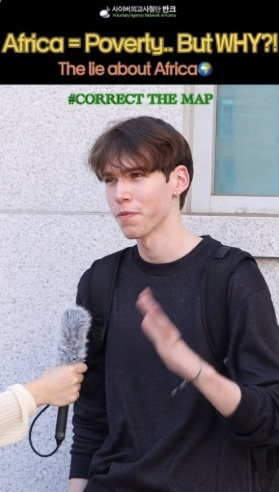
As the campaign’s first activity, VANK youth researchers conducted interviews in downtown Seoul with foreigners from the United States, Algeria, Canada, Hungary, and other countries. When asked what came to mind when they thought of Africa, most respondents cited negative terms such as famine, poverty, heat, and illness. A U.S. participant remarked, “In America, Africa is mostly depicted as a continent of poverty and conflict. People rarely realize it is actually rich in resources and full of potential.”
Many participants also underestimated Africa’s scale. Several assumed it was only the third-largest continent or even smaller than Greenland. They expressed surprise upon learning that Africa is the world’s second-largest continent, large enough to contain the United States, China, and all of Europe combined. A Hungarian student commented, “Map distortion is not just a mistake—it’s tied to history. Sharing accurate maps is essential to building a fairer perspective for humanity.”
VANK youth researcher Kim Ye-rae, who led the initiative, said, “We confirmed that many foreigners still think of Africa only as the continent of poverty and are unaware of its true size. Just showing people that the maps they’ve always trusted are distorted can change their worldview dramatically.”
The campaign is designed not only to correct geography but also to move away from one-dimensional narratives of charity and pity toward Africa, fostering mutual respect and cooperation instead. VANK plans to expand the project globally through social media challenges, the creation of accurate world maps, and collaborations with international organizations. The group has already called on Korea’s Ministry of Land, Infrastructure and Transport to limit reliance on the Mercator projection and has consistently promoted initiatives to raise awareness about Africa.
Park Ki-tae, head of VANK, underscored the importance of the campaign, stating, “Just as Korea overcame the scars of colonial rule and war to emerge as a major economic power and cultural hub, Africa is overcoming the legacy of colonialism and opening its own future. With over 200 million fans of Korean culture worldwide, Korea must take the lead as a global village leader, and I hope young Koreans will ignite the spark of change in perceptions of Africa.”
Participants concluded the Seoul interviews by chanting, “Let’s Correct the Map!” in a show of commitment to challenging distortions and reshaping global perspectives.