
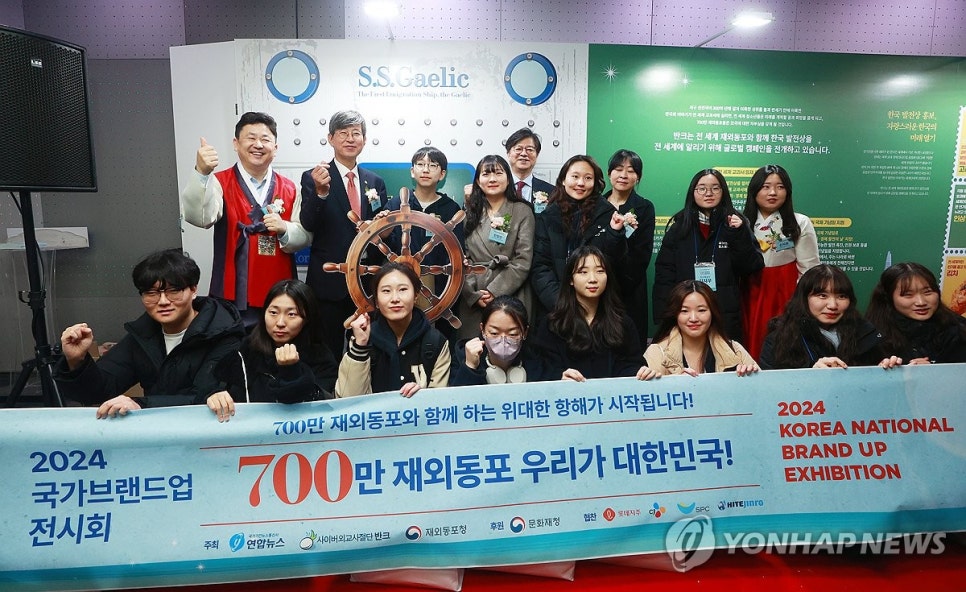
An exhibition honoring the history of 7 million overseas Koreans and showcasing South Korea’s unprecedented political and economic growth opened on February 22, 2024, drawing strong public interest. The event, titled the 2024 National Brand Up Exhibition, runs until February 27 in the underground passage of the National Museum of Korea in Yongsan, Seoul.
The exhibition is jointly organized by Cyber Diplomacy Organization VANK, the Overseas Koreans Agency, and Yonhap News Agency, with support from the Korea Heritage Service and the National Hangeul Museum.
The opening ceremony, held at 3 p.m. on February 22, was attended by key figures including Yonhap News Agency President Sung Ki-hong, who emphasized in his opening remarks that “overseas Koreans, who have endured hardships abroad and served as steadfast supporters of their homeland, are the true protagonists of this exhibition. They have acted as genuine ambassadors of Korea, raising the nation’s brand value around the world.”
Overseas Koreans Agency Commissioner Lee Key-cheol stressed in his welcome speech that “overseas Koreans have always helped their homeland in difficult times and served as bridges between Korea and their countries of residence. They are invaluable partners in building a global pivotal state.” VANK head Park Ki-tae added, “There are 7 million overseas Koreans in 193 countries. Though their beginnings 120 years ago were small, overseas Koreans have played a central role in Korea’s rise to become an influential global nation.”
Other attendees included Kim Hyun-jun, Yonhap News Agency Executive Managing Director for Business and Global Affairs; Chung Kyu-duk, head of Yonhap’s Global Korea Center; Kim Min-chul, Director-General of Overseas Koreans Policy at the Overseas Koreans Agency; spokesperson Wang Gil-hwan; Kim Young-geun, head of the Overseas Koreans Cooperation Center; Kim Il-hwan, Director of the National Hangeul Museum; Cho Dong-joo, Director of International Cooperation at the Korea Heritage Service; and Kim Jin-hee, Director of Global Public Relations at the Ministry of Culture, Sports and Tourism.
Prior to the opening ceremony, VANK and Yonhap held the inauguration of the 11th class of Youth Public Diplomacy Ambassadors at the National Hangeul Museum. Eighty-one middle school, high school, and university students from across the country were appointed as ambassadors and will carry out missions over the next month to promote Korea’s development abroad.
This year’s exhibition theme is “7 Million Overseas Koreans: We Are Korea.” The exhibition aims to promote Korea’s achievements by encouraging their inclusion in school textbooks in countries where overseas Koreans live.
The exhibition highlights Korea’s dramatic rise from a war-torn country with a per capita GDP of just $67 after the Korean War—dependent on foreign aid—to a member of the OECD and one of the world’s top ten economies. It underscores that among the 80 nations that gained independence after World War II, South Korea is the only country to have achieved both EU-level economic growth and democratization.
Building on this, the exhibition calls on Koreans at home and the 7 million overseas Koreans worldwide to work together to ensure Korea’s political and economic progress is properly represented in global textbooks, shaping a proud future for the nation.
VANK is also pursuing global campaigns to include Korea’s growth story in foreign textbooks, establish a “Korean Democracy and Economic Development Day” as an international observance at the UN, and create a Korean Democracy and Economic Development Memorial Center under UNESCO.
Visitors to the exhibition can explore the history of Korean immigration, which began in December 1902 when more than 100 Koreans departed Jemulpo Port in Incheon and arrived in Hawaii in January 1903. Exhibits highlight how overseas Koreans endured harsh labor and racial discrimination abroad, while donating their hard-earned money to fund the Korean Provisional Government and independence movement.
Hawaii Koreans contributed $2 million—earned through grueling sugarcane field labor—to the Provisional Government, even covering the trial costs of independence activist Ahn Jung-geun. In San Francisco, the Korean community raised $20,000 through the historic Korean National Association Church to support independence activities.
The exhibition also features an interactive corner where visitors can explore global “Korea Days” established with the participation of overseas Koreans. These include “Jikji Day” (September 4), adopted by the California State Assembly to commemorate Korea’s invention of movable metal type, and “Hanbok Day” (October 21), proclaimed by Tenafly, New Jersey.
In addition, Yonhap’s coverage of overseas Korean heroes is on display, along with exhibits showcasing VANK’s efforts to correct global misconceptions about Korea, a section dedicated to discovering “hidden Hallyu stars” in Korean history, and a photo zone symbolizing the shared journey of Koreans at home and abroad.