
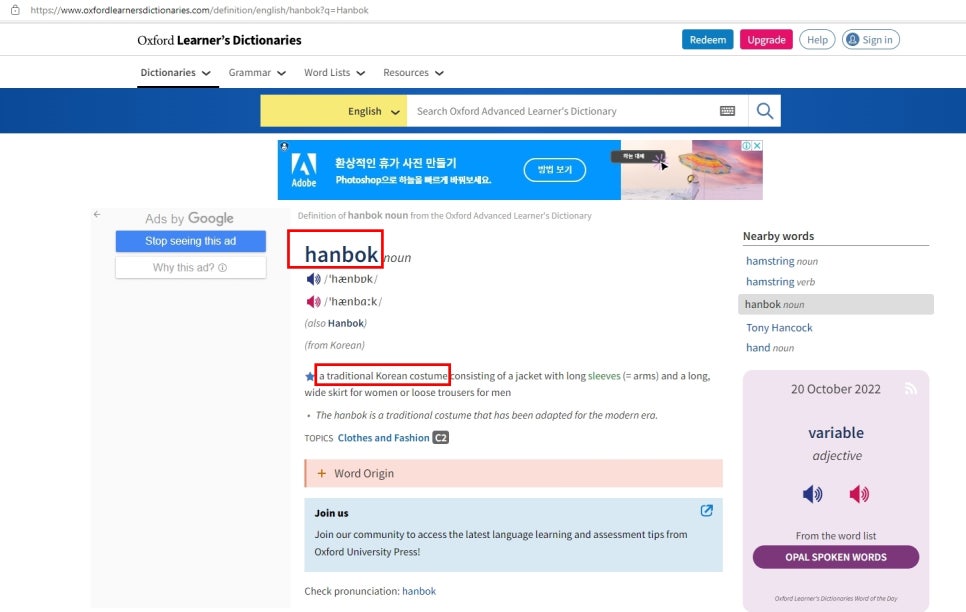
<2022.10> Thanks to the efforts of Cyber Diplomacy Organization VANK, the word “Hanbok” has been newly added to the Oxford Learner’s Dictionaries (OALD), a renowned English dictionary published in the United Kingdom.
VANK has actively campaigned to register Hanbok as Korea’s traditional clothing in major overseas textbooks, encyclopedias, and English dictionaries. This effort responds to attempts by China to misrepresent Korea’s Hanbok as China’s traditional Hanfu and spread the distortion globally.
As a result of these efforts, Hanbok was first added to the Collins English Dictionary in May 2021. Building on that success, VANK pursued the inclusion of Hanbok in another globally recognized dictionary, the Oxford Learner’s Dictionaries.
To achieve this, VANK researcher Shin Ji-won formally requested the entry of Hanbok into OALD starting in April 2021. In addition, Seong Ji-woo, who served as VANK’s “Digital Heritage Ambassador,” also submitted a request for inclusion.
Seong Ji-woo explained, “I searched for kimono in the Oxford Learner’s Dictionaries and found it listed as traditional Japanese clothing. Since kimono is included, traditional clothing from other cultures should also be recognized. Like kimchi, Hanbok is one of Korea’s most representative traditional cultural items and deserves inclusion.”
Thanks to these efforts, VANK recently confirmed that Hanbok is now officially listed in the Oxford Learner’s Dictionaries. Previously, searching for Hanbok returned the message “No results found matching Hanbok.” Now, the entry defines Hanbok as: “Korean traditional clothing consisting of a long-sleeved jacket (jeogori) and a long, wide skirt for women or loose-fitting trousers for men.”
It is important to note that the Oxford Learner’s Dictionaries (OALD) is a separate publication from the Oxford English Dictionary (OED).
Earlier in 2021, 26 English words of Korean origin were newly added to the Oxford English Dictionary (OED), another Oxford publication.
With China’s attempts to spread unfounded claims about Korean history and culture worldwide, proactive efforts to register Korea’s heritage in textbooks, encyclopedias, and dictionaries are increasingly important.
VANK hopes that the inclusion of Hanbok in a major international dictionary will encourage people worldwide—and foreigners learning Korean—to expand their knowledge beyond K-pop and the Korean Wave, learning about Korean history and culture through words listed in dictionaries.