
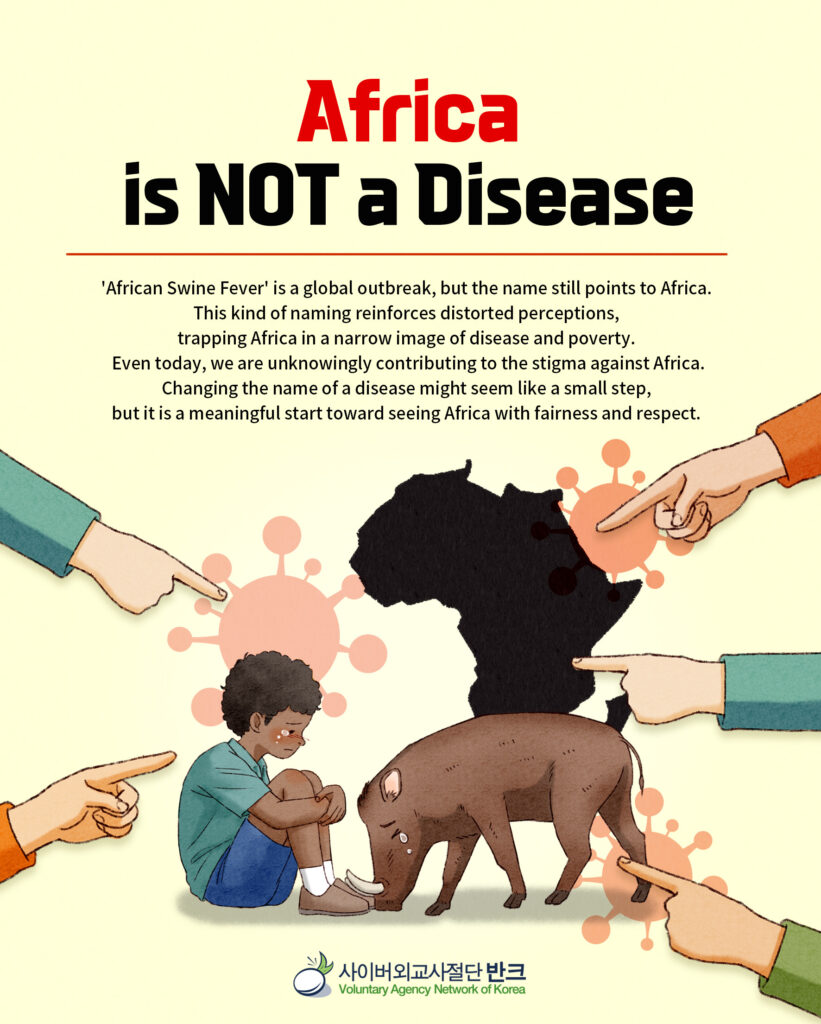
The Voluntary Agency Network of Korea (VANK) is launching a campaign to rename “African Swine Fever (ASF)” as part of its “Promote Africa Correctly” project, aiming to address stereotypes and prejudice embedded in disease names.
The campaign stems from concerns that the current name, “African Swine Fever,” links a specific continent to disease, potentially stigmatizing Africa. VANK is promoting a citizen awareness initiative to change the name to a neutral term reflecting the disease’s pathological features, such as “Hemorrhagic Swine Fever” or “ASF-type Swine Disease.”
The “Promote Africa Correctly” project seeks to counter the long-standing negative image of Africa as associated with “disease, poverty, and conflict,” helping the world view the continent from a more balanced perspective. This ASF renaming campaign is receiving attention as a practical effort to reflect on and correct the unconscious discrimination embedded in language that treats Africa as a symbol of disease.
Recently, wild boar habitats have shifted due to wildfires in the Yeongnam region, raising concerns about the nationwide spread of ASF. The disease is a viral hemorrhagic swine fever with a near 100% fatality rate and no available vaccine or treatment, causing severe damage to domestic pig farms. Since 2019, ASF-infected wild boars have been found in 43 regions in South Korea, prompting intensive measures to prevent further spread.
ASF was first reported in Kenya in 1921 and spread from African wild pigs, which is how it received its current name. However, despite the disease spreading to Europe, Asia, and Latin America, the name still contains “Africa,” solidifying a perceived link between a specific region and the disease. Such naming practices repeatedly reinforce negative perceptions of Africa in the international community.
The World Health Organization (WHO) issued disease naming guidelines in 2015 (WHO-HSE-FOS-15.1), advising against the use of names that evoke specific people, regions, animals, foods, cultures, races, or occupations. Improper naming can create unnecessary fear, stigma, economic damage, and social discrimination. Past examples include the 2009 influenza initially called “Mexican flu,” renamed “H1N1,” and COVID-19, first referred to as “Wuhan pneumonia,” which was officially renamed to avoid geographic association.
Nevertheless, ASF, along with diseases such as Ebola Virus, Crimean-Congo Hemorrhagic Fever, and African Horse Sickness, still use names linked to geographic locations. This practice continues to perpetuate unconscious bias and stigma associating specific regions or peoples with disease.
Based on this awareness, VANK is launching the ASF renaming campaign in earnest. Through posters, card news, Instagram content, and other online platforms, the campaign will use hashtags such as #AfricaIsNotADisease and #아프리카는병명이아니다 to raise public awareness and encourage citizen participation.
VANK Director Park Ki-tae said, “Disease names are not just terms; they are mirrors reflecting how we perceive specific regions and cultures. The name ‘African Swine Fever’ can reinforce stereotypes linking the entire African continent to disease.” He added, “If the international community values coexistence and respect, we must begin by changing language expressions, including disease names. We hope this campaign becomes a small turning point in how global citizens view Africa.”
VANK youth researcher Jeong In-sung, who planned the campaign, said, “Disease names influence how we perceive the world and understand other cultures. Names that evoke a specific continent or region can entrench prejudice and stigma.” He noted, “The WHO’s recommendation to avoid geographic terms in disease names stems from this reasoning. ASF should also be redefined with a neutral name reflecting its pathological characteristics.”
Jeong added, “Changing disease names is not a simple linguistic adjustment but a meaningful step toward removing long-standing stereotypes imposed on a continent.”
VANK plans to continue analyzing repeated stereotypes about Africa in disease names, maps, textbooks, and media, and carry out global citizen awareness activities to correct them. This effort goes beyond renaming, aiming to change perceptions and attitudes worldwide and to promote a more respectful and fair society through international civic action.
Meanwhile, VANK and the national news agency Yonhap News Agency have signed an agreement to train Global Ubuntu Ambassadors, leveraging the influence of some 200 million Hallyu fans to improve perceptions of Africa and highlight its potential and value.
VANK also operates the policy proposal and communication platforms Woollim and Yeollim to develop Korean policy as part of Hallyu, share it with the world, and contribute to improving global awareness.
Through these efforts, VANK hopes the interest of 200 million Hallyu fans will expand beyond Korean pop culture to Korea’s rich history and broader global policies, evolving into “K-Policy Hallyu.” The initiative aims to position 21st-century Korea as a central hub in Asia, a gateway in Northeast Asia, and a nation sharing dreams and friendship globally, creating a new national brand that leads worldwide change.